

Unlocking the Secrets of Friendship
A Philosophical Guide From Plato and Epicurus, to Heideggerian Ludditism, RedPill slop, the Internet, and Everything in Between.

Lots of attention in modern discourse is paid to self-help and, in more erudite circles, self-overcoming, which carries a distinct Nietzschean flavor. The primary purpose of life is the work one does upon oneself, after all—the sculpting of character, the sublimation of base desires, the relentless pursuit of one’s highest potential. Or so it goes. It is a vision that appeals deeply to our individualistic age, promising autonomy and self-sufficiency as the ultimate rewards. However, this might fall prey to the all-too-typical disease of our time: social atomism. For all the talk of self-actualization, I can’t help but wonder: for what without an edifying community?
This much-ignored topic, yes, is friendship. To those who know me through personal Substack exchanges, I genuinely consider you my friends. This might seem perplexing, as we think that friendship can only be achieved with those in the flesh and in close quarters. However, I digress, and in this sense, the internet, when used in an illuminating manner, gives us access to a global community of like-minded friends that would have been impossible to achieve a few decades ago. The friendship that fosters a fellowship of eagles is right at our fingertips.
PART 1: What is Friendship?
What is beauty? What is truth? What is virtue? Everyone has different definitions for such concepts. Asking that very question—“What is friendship?”—implies that there is a static, immutable principle for that idea. You might be tempted to believe that I’m here to unravel the “form of friendship”—the true essence that is clouded by smokescreens long lost in time, or hiding beyond the pale. What I can humbly offer, my friends, is a genealogical case, a philological anatomy of the evolution of friendship that will make such an idea clearer.
They say that philosophy is a series of footnotes to Plato, and it occurs to me that what better way to feed such mundane platitude than to start with him? There is a rarely read Platonic dialogue on friendship, Lysis, that is overshadowed by the Symposium or Phaedrus in their treatments of eros or love. In Lysis, we encounter a homoerotic scene in which Socrates engages in one of his favorite, albeit peculiar, pursuits: philosophical dialogue with teenage boys of noble birth and handsome appearance. One of these boys, Hippothales, happens to see Socrates on his way out of the Academy in the direction of the Lyceum. He promptly invites him to accompany him to a wrestling school with the added boon that “There are quite a few besides ourselves—and they’re all good-looking.”1 I know, how enticing.
If you are already disgusted, then buckle up, as the homoerotic remarks don’t end here. Not one to deny such an invitation, Socrates asks first who is the best-looking member to check what he is working with. Hippothales blushes like a little girl: he is in love with a certain Lysis, as his friend Ctesippus teases him for, and no other answer could escape from his mouth. He serenades him, writes him poems, and gushes over him. Socrates will teach this boy a lesson: that the way to gain such a boyfriend is not by inflating his ego, thereby making him even more out of reach, but by embarrassing him.
“This is how you should talk with your boyfriends, Hippothales, cutting them down to size and putting them in their place, instead of swelling them up and spoiling them, as you do.”2
I hope that my gay readers are taking notes. It is suggested that genuine friendship may require something more than mere admiration: utility and humility. But why begin a dialogue on friendship with such debauchery, you might wonder? Back then, there was a strange belief that genuine friendship could only be attained by men. There was also a curious custom where older men would take certain young male pupils under their wing and become real close friends. I’ve found this perplexing, yet what follows this bizarre exposition is a dry, soporific Socratic dialogue on friendship. Socrates asks Lysis about his relationship with his parents. They arrive at this initial conclusion: those who love you, like your legal guardians, keep you away from things that may cause joy for you. They will only trust you and give you freedom to do what you want once you have knowledge, wisdom, and come of age. Without wisdom, one is useless, and a useless one can hardly be loved. Keep this in mind: the utility thesis, which posits that friendship depends on being useful or good.
Following Socrates’ colossal deconstructive impulse, we realize that friendship cannot be located solely in the beloved, the lover, or even in mutual affection—each proposed definition only deepens the puzzle. Is a friend someone who permits you to pursue all your desires? If so, does that make those who set boundaries—like a parent—a true enemy? In one of his few aphorisms on friendship, Nietzsche says a proper friend should also be an enemy.
If one would have a friend, then must one also be willing to wage war for him: and in order to wage war, one must be CAPABLE of being an enemy.3
How seemingly paradoxical isn’t it? But it rings right. We don’t want friends who are mere “yes-sayers,” who appease us and let us lose ourselves. Yet if friends are enemies, we fall into a paradox.
A friend could be found between alikes, as the old saying goes: “God always draws the like unto the like… and makes them acquainted.”4 If that were the case, then what about bad men who are alike and cause harm to one another? Following this logic, wicked men are alike but enemies. Consequently, Socrates tentatively suggests that good men are self-sufficient and have no need of each other. However, can friendship be found between those who are unalike, as Hesiod’s received wisdom would suggest when saying that those who are alike are actually enemies?
“Potter is angry with potter, poet with poet
And beggar with beggar.”5
Yet we find ourselves in a paradox again. What, then, is the true foundation of friendship? And what does a friend truly love in their friend—and how does that love relate to the essence of friendship itself? Can friendship exist only with the virtuous? Can something neither good nor bad be a true friend to what is good? If a sick body (morally neutral) seeks medicine (something good) only because of illness (something bad), then friendship becomes merely instrumental: a remedy for suffering, not a bond of virtue. Thus, desire may arise from deficiency. If every friendship were merely a means to an end—like health or happiness—we’d face an endless loop. There must be something valued for itself, not as a stepping stone. Yet Socrates finds a twist: if we love something only to fix a flaw, removing the flaw might make it unnecessary. Still, desires like hunger or thirst persist even without flaws—suggesting desire itself may be the true engine behind friendship.
Socrates then proposes that friends naturally “belong to one another.”
What belongs to oneself[...] that passionate love and friendship and desire are directed towards.6
And yet again, this is problematic because it means that ‘like is friend to like,’ which, if you have kept up with this whole spiel, has already been rejected. I’m exhausted from writing all of that. If you are suffering from internet-induced brainrot, I commend you for still reading this so far.
Back on topic, we have reached a stalemate! We find ourselves at an impasse. No matter how hard we try, we can’t seem to find a suitable first principle for friendship. On a humorous note, after finishing his conversation with Lysis and his best friend Menexenus, Socrates says,
“Now we’ve done it, Lysis and Menexenus—made fools of ourselves, I, an old man, and you as well. These people here will go away saying that we are friends of one another—for I count myself in with you—but what a friend is we have not yet been able to find out.”
This marks the main feature of Plato’s early dialogues: the inconclusive ending in paradox, aporia.7 The mystery of friendship is still open. Our case has only begun. We know now, at least, what friendship isn’t. Whatever our true “form of friendship” may be, it cannot be an instrumental type of friendship, the reduction of personal relationships to utility. Instead, for friendship to rise, someone must be desired FOR THEIR OWN SAKE!
Can I Love You if I’m Using You for my Pleasure?
We find a natural continuation to this line of reasoning in Plato’s most famous student: Aristotle. While Aristotle and Plato are often portrayed as philosophical opposites, it’s more insightful to view Aristotle’s work as a thoughtful response and development of Plato’s ideas. Aristotle views friendship as a “certain kind of virtue,” going as far as considering friendship an absolute necessity for human life, claiming that “no one would choose to live without friends, despite having all the rest of the good things.”8 This seems reasonable enough.
In Nicomachean Ethics Book VII, Ch. 3 and Eudemian Ethics Book VII, Ch. 2, Aristotle identifies three types of friendship. Continuing our “conversation” with Plato, the first type of friendship is one based on utility. This is the type of relationship where people “love” each other for some benefit they receive. This is the weakest type of friendship, according to Aristotle and Plato, because, clearly, once that benefit ceases to be useful, the friendship, too, ceases to be.
The second type of friendship is one based on pleasure, functioning as a derivative of utilitarian friendship. Think of boomer friendships based on convenience—business partners’ friendships are overtly utilitarian. On the other hand, younger people may be prone to friendships based on feeling good. The friendship of two young psychedelic cosmonauts may come to mind. Or think about the love of a young couple, during that time when relationships may last only a few months, luckily. Aristotle says,
The young are also lustful, since the greater part of sexual love results from passion and is based on pleasure; this is why they love and stop loving quickly, often changing within the same day. And the young do wish to pass the time together and to live with one another, since what they get out of friendship comes about in that way.9
However, you might assume that we are being too quick to dismiss such a line of reasoning. Now, imagine that you are an egoist. You uphold that we are primarily self-interested. The highest principle is the attainment of one’s own pleasure. Yes, you care about others, but only insofar as they are beneficial to you. What is friendship in that view, my seemingly Reptillian friend? We can establish friendship, first, on mere utilitarian grounds: having friends offers personal advantages—a shoulder to lean on during tough times or a lavish wallet to leech on if we play our cards right.
This seems to be a much too mechanical and dispassionate way of viewing friendship. This is the friendship of the businessman, or worse, of the social climber. As mentioned previously, this type of friendship can be parasitic, dissolving in the blink of an eye whenever the advantage to one party is terminated. It reduces the other to a function, a resource to be managed rather than a person to be encountered. Yet, what if I told you that there is an ancient brand of literal egoistic hedonists, the Epicureans, who believed that…
27. Of all the things that wisdom provides for the happiness of the whole man, by far the most important is the acquisition of friendship.10
Interlude in Garden
When we think of “Epicureanism,” we think of lavish gardens or gourmet food. Some of you may equate it with debauchery: orgies, drug use, or public nudity. When listening to the term “egoistic hedonist,” you might imagine that this is materialized by picking up women, gaining social status, making bank, and getting your way. It’s swallowing Patrick Bateman’s Kool-Aid, but instead of dying in the jungles of South America at the instruction of a charismatic cult leader, it’s about being in the midst of a Chaddian apotheosis. BASED… or something to that tune. This remains completely alien to the Hellenistic school of Epicureanism when properly grasped.
This misunderstanding comes from Stoics and later Christians who slandered the Epicureans as moral degenerates. The Christians would, conveniently, tie this down to their atomic, materialist ontology. Diotimus the Stoic notoriously published 50 sexually salacious letters posing as Epicurus to portray him as a depraved man. Dante famously banished Epicurus to the “Sixth Circle of the Inferno.” Augustine charges him with turning “the virtues into the slaves of carnal desire.”11 This provides us with the common trope of the “Epicurean Pig.”
The Epicureans do identify pleasure as the highest good. A good life seeks to maximize pleasure in their view. However, what we see in the Epicureans is a sober kind of hedonism. They are not pleasure junkies, chasing grandiose highs or oppulence. Pleasure is defined primarily as the removal of all pain, either bodily distress (aponia) or, more importantly, mental distress (ataraxia). Epicurus explicitly distances his goal from the popular pleasure junkie stereotype:
When I say that pleasure is the goal of living I do not mean the pleasures of libertines or the pleasures inherent in positive enjoyment... I mean, on the contrary, the pleasure that consists in freedom from bodily pain and mental agitation.12
In reality, then, the Epicureans are closer to ascetics than to vitalist irrationalists. The “ascetic” nature of the school arises from its focus on self-sufficiency (autarkeia), which protects the individual from the “whims of chance” by minimizing needs:
“We consider self-sufficiency a great good, not in order that in all circumstances we use little, but so that, if we do not have much, we be satisfied with little“.13
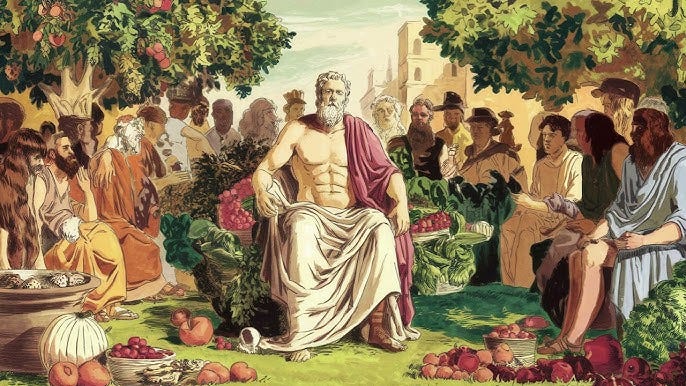
Now the stage is set. Perhaps, there is a way for egoistic hedonists to have utilitarian friendships. Epicurus calls friendship an “immortal good”14 that “dances round the world, summoning every one of us to awaken to the gospel of the happy life.”15 As was common back then, philosophy wasn’t a mere set of word games, but a living practice. In 306 BCE, Epicurus set up the “Garden” in Athens—a communal living space open to everyone, including women and slaves, which was pretty radical for the time. Friends there kept each other philosophically sharp through honest, frank feedback, and they lived and studied together to stay grounded.
This seems very charming, very sweet—only a rainbow over a sunset is missing. However, of all the ancient Hellenistic schools of philosophy, the Epicureans had a surprisingly practical—almost cold—take on friendship. Their starting point? Friendship exists because it’s… drumroll… useful. A Stoic would say that we humans need friends because we are naturally social creatures, but an Epicurean would say that having friends is simply a smart move.
The biggest perk of friendship, in their view, is security. You have heard the siren songs toward hermitship. You might want to go full Kaczinsky and build a shack in the woods, withdrawing from this corrupt modern world to live a peaceful life of solitude. That works in a vacuum. Even Zarathustra had to go down the mountain to visit the little people and spread his gospel.

In the past, without the polis to support you with food and trade, say during the case of an invasion, you would have starved to death. Life is risky, and a solid crew of friends acts like a mutual aid network—people who’ve got your back when you’re sick, broke, or in trouble. Interestingly, it’s not even the help itself that matters most, but just knowing help is there. That sense of assurance is what keeps you calm and worry-free, attaining what the Epicureans called ataraxia—one of the necessary components of the good life.
34. It is not so much friends’ services that we find serviceable as the assurance of their services.16
Now here’s where it gets philosophically messy: if you only care about your own pleasure, why would you ever genuinely care about someone else? This is the paradox of the egoistic hedonism that Epicureans uphold versus their altruism. Plato and Aristotle left us with the conclusion that a friend can’t be instrumentalized, but loved for their own sake. Later critics, like Cicero, argued that if a person only values their own pleasure, they can’t TRULY care for another. The Epicureans had a few answers to this:
Recall that earlier in the essay, I mentioned that Aristotle believed friendship to be a “certain kind of virtue.” Plato would seemingly consider the virtues as a certain objective form. Aristotle would consider a “virtue” to be perfection of character through habituation and contemplation towards a teleological end: eudamonia (total human flourishing) and to kalon (the beautiful/noble). The Epicureans would reject this framework, conceptualizing “virtue” as an advantageous social construct for the attainment of a pleasant and untroubled life. Therefore, they adopt a ‘practical policy approach.’ Epicureans do realize, as mentioned before, that friendship cannot be stable unless we treat a friend as well as ourselves. Yes, this is somewhat of an echo of the Christian golden rule, except that instead of being a putative instruction from God, it is an instrumental-behavioral policy. Treat your friend as well as yourself, not because you love them, but because that's the only way to build the trust that keeps you feeling secure.
What follows is something like a social contract: wise people agree to look out for each other so everyone can live more pleasantly. Like the libertarian Non-Aggression Principle or the social contract of justice, friendship is a pact of mutual beneficence. However, we encounter another problem: the Epicureans believe that you should die for a friend,17 which seems to violate the pursuit of one’s own pleasure, as dead people can’t feel good any longer, as Bentham would suggest.
It sounds contradictory, but the logic holds up: betraying a friend to save yourself would wreck your peace of mind for the rest of your life. And since death is just... nothing (no sensation, no suffering, just ceasing to exist, for the Epicurean), it might actually be the better option than living as a traitor. If we were to conduct a cost-benefit analysis of our emotional state in the aftermath, and assuming we are not psychopaths, we would likely find ourselves overwhelmed by negative emotions in the wake of betrayal. The attainment of ataraxia becomes impossible, haunted by the mental turmoil, the anxiety of failing a friend.
I can’t help but feel that almost no one does a cost-benefit analysis for friendship. It is an intuition, but thinking “I will listen to this guy because he will help me in the future once I’m old and frail,” is much too unfriendly. This view still leaves something to be desired. Some later Epicureans, like Philodemus, admitted that over time, you just... start genuinely caring. Kind of like how you get attached to a place or a pet. It’s a warmer take, but it does ditch the strict “only my pleasure matters” rule of the older, bolder Epicureans.
At the end of the day, friendship was the heart of Epicurean life. It turned a simple, modest existence into something rich, stimulating, and enlightening—elevating the wise person. Though the Epicureans embraced egoistic hedonism, they recognized more deeply than any other philosophical school the vital importance of fostering a meaningful, uplifting community. It seems to me that the recognition of later Epicureans that a friend is valued for their own sake marks a defeat of the most sophisticated take on pleasure-based friendships. Ultimately, friendship allows the Epicurean to achieve a state equal to that of the gods, “living like a god among mere human beings.”18
The later Epicureans, bless their inconsistent hearts, admitted defeat on the pure utility model. A friend, it turns out, does get valued for their own sake after a while—even if you start as a cold calculator. So, the paradox of egoistic hedonism never really gets resolved; it just gets... outgrown. Fine. Let’s grant that friendship can’t be only instrumental. But that opens a nastier can of worms: if utility and pleasure aren’t the real glue, then what is? And if the answer has something to do with virtue, or like-mindedness, or “loving the friend as another self”... well, then we have to ask a question that makes modern people squirm.
WAIT, DAWG, BUT CAN MEN AND WOMEN BE FRIENDS?
Wow, you ask such deep questions, my hypothetical interlocutor. Indeed, don’t men and women use each other for pleasure? And don’t men and women find it hard to love each other for their own sake? Isn’t there possessiveness and exclusivity in relationships? However, if we are in a romantic relationship, can we truly classify that as a friendship? It might be possible to conclude that men and women can’t be friends. This could be the most profound question in this essay, perhaps ever—the dog can’t skip this. We will reverse-engineer this and begin with a popular modern account: inter-gender friendship according to RedPill slop.
When I was a lost puppy at 17 years-old, I said to myself: I want a girlfriend. And so I did what any smart, noble pup would do: I googled “how to get a girlfriend.” I sifted through many WikiHow articles: signs she is into you, how to attract women, etc, etc. Eventually, after hours of slashing through the dense foliage of internet advice, I found the holy grail: the REDPILL! I encountered the most intelligent, judicious, and intellectually lucid account of men and women in Rollo Tomassi’s The Rational Male. We will jump to the chapter on inter-gender friendships.
Rollo basically doesn’t believe that men and women can have real friendships. You may have noticed that, as a guy, forming friendships with girls often feels different—sometimes less similar in depth or dynamic—compared to friendships with other guys. We see a bold claim:
Most men will only ever engage in friendships with women that they initially find attractive which then, of course, is colored by their attraction to that woman.19
Our intersexual attraction muddies the waters. Adopting a friendship template where we assume same-sex equality is wrong. Rollo spends a long time arguing that if your boyfriend or girlfriend spends a lot of time with a “friend” of the opposite sex, then that will cause friction. Someone will inevitably become jealous, and then the relationship goes boom-boom. Or what if a seemingly genuine female friend gets a boyfriend? Wouldn’t that deteriorate the quality of your friendship? It very well could—heck for Rollo it sounds like it WILL!
Even the best, most asexual, platonic, male-female friendships will be subject to mitigation based on sex.20
There is an aura of haughtiness or extreme self-assurance in Rollo. What’s left behind is this feeling that you can have female acquaintances, but not female friends. By the very nature of inter-gender social dynamics, aspiring for a legitimate friendship between the sexes seems impossible under his framework.
There are fundamental differences in the ways men and women view friendship within the framework of their own sex and the ways this transfers to the concept of intergender- friendship.21
As a man, you might tolerate shit from a “female friend” that would otherwise end with you throwing down punches with a male. Men can hardly engage seriously with the typical girl-talk: gossip, celebrity slop, and day-to-day bullshit abounding. And in a friendship with a girl, a male descends to the female-centric friendship frame, not the male one. Alas, the great UBER-RATIONAL Rollo has made his case—nay, his verdict! You can have female acquaintances, but not genuine female friendship.
Despite being called “The Rational Male,” there are a lot of unspoken assumptions in his work. As we might recall from the Lysis dialogue, it is not at all obvious that friendship is better between those who are similar or dissimilar. Yes, inter-gender dynamics are different, but why would it be the case that grasping the “form of friendship” seems to only be possible between those who are alike? I’m not saying Rollo is wrong, only that his analysis is flat. We have to keep trudging along, as perhaps there is something to the idea of friendships between likes.
I was talking with my girlfriend about Plato’s Lysis dialogue. She didn’t care about anything I said, really. However, she overfocused on one thing, not letting go, no matter how hard I tried to explain it: why is Plato only talking about men in friendships, and why is it homoerotic? Believe me, I tried so hard to steer the attention of the conversation away from slightly gay friendships and into the esoteric meaning of the dialogue. Still, her will proved stronger: yes, we got nowhere LOL. If I were petty, I would make a generalization that women tend not to be built for philosophy. We have to introduce Aristotle’s account of women, as seen in Politics, to get an explanation for a statement that is bothersome to our modern sensibilities.
Ancient Greece was a patriarchal society—this is hardly news to most readers of this publication. As BAP points out in Selective Breeding and the Birth of Philosophy and Bronze Age Mindset, the default mode of humanity is a matriarchal tribe where intellectual dissent is anathema. VERY Ancient Greece was no exception. The Minoans produced snake goddess figurines before their civilization was conquered by the Mycenaeans around 1450 BCE. The Mycenaeans, who migrated due to overpopulation, developed the concept of the polis, and their bards probably “composed” the epic works known as the Iliad and the Odyssey—though their own culture had likely been influenced or previously conquered by Indo-Aryan groups. The emergence of the Aryan tradition—marked by their sky-father deity, horse-drawn chariots, and robust physiques—introduced patriarchal values that would become deeply rooted in Greek society, as seen in Pindar’s poetry, the Homeric epics, or the Olympic Games.
Fast forward to Aristotle, a philosopher who takes received wisdom in a better light than Plato. Book I of the Politics deals not only with the origins of the polis but with the structure of the household as a foundational unit. For Aristotle, it is obvious that the relationship between the sexes is unequal.
The male is by nature superior, and the female inferior; and the one rules and the other is ruled; this principle of necessity extends to all mankind.22
This relates to the capacity for command, an area where women appear to rank second to men.
The male is by nature more suited to leadership than the female, unless something in his make-up runs contrary to nature.23
Finally, although most idiots are drooling for me to say that women are irrational, Aristotle didn’t believe that.
The slave wholly lacks the deliberative capacity, while the [Greek] female has it, but without authority.24
According to Aristotle, friendships between men and women are inherently unequal—it seems that Rollo was echoing this.25 In the Nicomachean Ethics, he asserts that the bond between husband and wife is “present by nature,” as humans are naturally inclined to pair off—even more so than to form communities.26 While this relationship offers mutual utility and pleasure, Aristotle adds that it can also rise to the level of virtuous friendship, provided both partners are morally upright. The virtuous or complete friendship is…
But the complete sort of friendship is that between people who are good and are alike in virtue, since they wish for good things for one another in the same way insofar as they are good, and they are good in themselves. And those who wish for good things for their friends for their own sake are friends most of all, since they are that way for themselves and not incidentally; so the friendship of these people lasts as long as they are good, and virtue is enduring.
But there is a glaring contradiction in the Nicomachean Ethics regarding complete friendship. This is the highest form of friendship. It involves “sharing conversation and thinking” between equals(!) who treat the friend as another self.27 Problem: Men and women are unequal, according to the accounts we have heard in this section. As we noted before, Aristotle views women as incapable of performing the “mastercraft,” which is political command.
Women also possess deliberative faculties, but lack “authority” (akuron). Joe Sachs, a great Aristotle scholar, points out in his translation of Politics that:
66 The word akuron was commonly applied to laws that were either invalid or unenforced.
Aristotle could mean that the deliberative capacity in a woman is without force either because it is by nature weaker in her than feelings or because it is conventionally unrecognized and unrespected.
So, since women can’t philosophize at the same level as men can, since they don’t possess the same intellectual authority as men, they can’t have the highest, complete form of friendship. Those are friendships of “serious worth” that they find themselves unable to achieve. As I pointed out in §IX of my musings on Aristotle, there is an esoteric core within his philosophy that is radically Luciferean: he wants the advent of the god-like philosopher. He also seems to think that like-mindedness is necessary for friendship… and complete friendship is only available for philosophers...
And friendship seems to hold cities together, and lawmakers seem to take it more seriously than justice, for like-mindedness seems to be something similar to friendship, and they aim at this most of all and banish faction most of all for being hostile to it. 28
Alas, I just pulled a great bait-and-switch on all of you! What started as a sloppy discussion on intergender friendship dynamics ended with a bang: the friendship of philosophers, the “fellowship of eagles.” As we can see, friendship in its deepest sense seems to be impossible for mere humans, not only men and women. Goodness gracious, is friendship that holy!? Is the blessed friendship out of reach for you, my 100 IQ reader who is struggling to keep up with this rant!?
So, are you really, really telling me that COMPLETE Friendship is only possible for Philosophically-Inclined Homosexuals?
This is complex, and I suspect you’re still focused on the homoerotic undertones in this essay. Yes, Lysis does depict an unusual male infatuation. It also suggests that true friendship is only possible between the sexes—since inter-gender relationships are said to lack mutual appreciation for intrinsic worth—and that women, deemed less rational than men, are incapable of attaining the highest perfect “form of friendship.” I’m obligated to explore this topic further. Surely, females can have ideal intra-gender friendships, right?
I traversed the vast wastelands of this wretched Earth, seeking ultimate answers, for my thirst for knowledge surpasses all lesser impulses. At last, I found myself standing within the Temple of Apollo. There, I sought the timeless wisdom of my beloved girlfriend, hoping to receive enlightenment from a Delphic priestess of the 21st century. It takes some prodding and careful word selection to find the suitable configuration that will privilege mere mortals to a constructive response from such an oracle. Alas, we hit the jackpot.

Delphic Oracle: “Lost pup, why do you ask such questions that need no examination? The answer has always been right in front of your nose. Hear me out, for I will only say this once: bitches be crazy.
Okay, I admit, I did not, in fact, visit a Delphic oracle to find this answer. But my girlfriend did agree that female intra-gender friendships have an inferior quality to their male counterparts. She remembered the numerous friendships among girls in her school years that had fractured over boys. Alas, we can’t escape Rollo’s OMEGA RATIONAL revelations. Even in intragender friendships, sexual attractions can create friction. Females seem to be more prone to breakups, catfights, and petty passive-aggressive showdowns to win the favor of an alluring man.
We get frustrated because women communicate differently than we do. Women communicate covertly, men communicate overtly. Men convey information, women convey feeling. In relating information, men prioritize content, women prioritize context.29
Rollo characterizes friendships within the female gender as being fundamentally defined by covert communication, psychological warfare, and intense competition anxiety. Men go to blows when there are problems, confronting each other directly when one party wants respect or their perceived fair share. On the other hand, girls are like HIV. As Rollo says, “Women are crazy, but it’s a calculated crazy.”30 They wait silently, holding their petty grudge for a long time to find the right opportunity to attack. Girls use the threat of “I won’t be your friend anymore if…” to fight for dominance among themselves.
Essentially, Rollo thinks female friendships are often a mere facade for underlying competition. He describes this as “intra-gender warfare” driven by the need to secure the best possible male partner (hypergamy).31 This is where slut-shaming, gossip, or calling each other ugly behind their backs become weapons in their quest to find the optimal male partner. Within this framework, the female social hierarchy is dictated by the male partner they have, and this takes precedence over genuine platonic female friendships.
The girl hierarchy is also led by alignment with the tribe’s herd mentality. Women in the West often express alignment with variations of woke moralism as a way to signal social status. Ultimately, while they may appear cooperative on the surface, they are governed by an outwardly schizophrenic need to both align with other women for social reinforcement and simultaneously sabotage them to optimize their own hypergamous interests.
Male friendships seem to have a more positive quality. We have already been flirting with this idea so far throughout this essay. It seems that men are more able to set aside competition driven by biological imperatives, utility, or base pleasures to love a friend for their own sake. In Montaigne’s essay “On Friendship,” he suggests that bonds formed through family, love, or marriage—those rooted in “nature” or “law”—allow less freedom and are therefore less perfect than friendships freely chosen.
As we have noted, the perfect “form of friendship” demands intellectual communion, constancy, and love for its own sake. These are not typically found in marriage or romantic love. Romantic love is ephemeral, passionate, and marred by highs and lows. On the other hand, friendship is a “general and universal fire, temperate and equal, constant, established, all gentle and smooth.”32 We must address the Greek model of Love as seen in Plato’s Academy, as insinuated multiple times early on, to find answers.
Montaigne, ever the wry observer of human folly, doesn’t shy from the awkward truth: the classical Greek practice of male love—what we’d now call pederasty—was, in his day, “justly abhorred by our manners.” Yet he doesn’t dismiss it outright; instead, he dissects the Platonic/Academic model. According to that tradition, love began with the eye—drawn first to the external beauty of a young male, yes, but for the nobler souls, it ascended: from flesh to virtue, from form to wisdom. This is beautifully exemplified in Plato’s First Alcibiades and the Symposium dialogues.
The beloved, the younger, was held in higher esteem than the lover, the elder—an inversion of power that still unsettles modern sensibilities. And here’s the turn: this erotic spark, if properly cultivated, didn’t end in possession or decay—it ended in friendship. Montaigne pulls in Cicero, who also has a friendship essay that pretty much only repeats what Aristotle said, a crisp definition he grabs from the Stoics: “Love is a desire of contracting friendship arising from the beauty of the object.” Not lust, not ownership—friendship, born of admiration, refined by time. The most carnal beginning, the most spiritual end.
So, Montaigne comes up with something he audaciously calls “perfect friendship,” which is a fusion of one soul in two bodies. This can only be achieved by two individuals, two “perfect friends.” This is why conventional notions of friendship—such as generosity, gratitude, and obligation—prove inadequate in his analysis. Moreover, women seem unable to form this friendship according to the genealogy we have built up so far. Montaigne says:
[…] it is without example that this sex has ever yet arrived at such perfection; and, by the common consent of the ancient schools, it is wholly rejected from it.
The underlying reason, as we’ve observed repeatedly, traces back to familiar patterns and enduring societal dynamics. While men are often capable of cultivating deep romantic bonds with women and forming friendships that encompass both physical companionship and emotional intimacy, the kind of profound, soul-level friendship—rooted in intellectual kinship, mutual admiration for the sake of friendship alone, and the resilience to withstand time and hardship—remains, according to historical and philosophical observation, far more difficult for women to achieve. Montaigne, in his reflections, alludes to this elusive ideal: a connection that transcends utility or pleasure, one that thrives on shared thought, unwavering loyalty, and the quiet strength of mutual understanding. Such friendships, he implies, demand not just affection but a rare alignment of minds and spirits—an alignment that, in his view, women fail to achieve, leaving them perpetually on the periphery of this most exalted form of human bond:
Moreover, to say truth, the ordinary talent of women is not such as is sufficient to maintain the conference and communication required to support of this sacred tie; nor do they appear to be endued with constancy of mind, to sustain the pinch of so hard and durable a knot.
Montaigne’s basic conclusion in this essay reads like Aristophanes’ account of eros in Plato’s Symposium. Aristophanes tells us a mythological account where our greatest desire (eros) is to pursue our original wholeness. Although the dialogue is seemingly set up to make Socrates the usual pompous smartypants who walks circles around his philosophical lessers, this little eulogy of Aristophanes is a serious stepping stone in Plato’s thought. According to Aristophanes, there were originally three kinds of humans below the gods: males (the offspring of the sun), females (the offspring of the earth), and a hermaphrodite race (the offspring of the moon), which combined male and female.
This androgynous race was particularly strong, having four arms, four legs, and two identical faces on a single head. They were powerful, fast, and ambitious—dangerous for the hegemony of the Olympians. They attempted to storm heaven, arranging a large-scale attack to dispose of the gods. To weaken them, Zeus decides to split each of these persons into two. And so, we seem to be trying to gain that sense of originary wholeness. Aristophanes illustrates this with the image of the god Hephaestus offering to weld two lovers together into a single being so they would never be apart, even in death. He claims no one would refuse such an offer because everyone’s heart desires to melt into their beloved and become one whole again.
Indeed, maybe Plato has an understanding of this immense desire that goes above the male/female duality. We have raved about the perfect friendship of “philosophically inclined homosexuals.” Perhaps, we must go beyond this:
And so, when a person meets the half that is his very own, whatever his orientation, whether it’s to young men or not, then something wonderful happens: the two are struck from their senses by love, by a sense of belonging to one another, and by desire, and they don’t want to be separated from one another, not even for a moment.33
Soul Sexlessness and Friendship?
It has become quite the meme to say that women are retarded. Indeed, it is women who vote for the left—a signal that they tend to support woke policies, like third-world immigration in Western nations or equity-based selection, that ultimately harm their own nations. Do I need to pull out graphs that point out that grown men are, on average, eight IQ points higher than women? Do I need to stoop so low as to point out the abysmal track record of female philosophers? Is it not embarrassing that the only interesting female philosopher ever was Ayn Rand?
There has been more than enough shitting on women here and on the internet. One thing still seems clear to me: a woman can rise to achieve that perfect “form of friendship.” Yes, MOST women are not only philosophically illiterate, but willfully ignorant. Yes, MOST women do default to hypergamy, petty drama, and the will of the herd. But this is not necessarily the case 100% of the time. And so, the one exception does break the rule. We can’t be as daring as to say that there is an ontological fixation that makes women permanently “inferior” to men.
This whole philosophical genealogy began with Plato. I deliberately fed into the ideas of reactionary men. You might have been gagging for me to say: YES, ONLY MEN CAN BE FRIENDS, AFTER ALL! I’ve been holding back a key insight: Plato had feminist tendencies, and this significantly reshapes our investigation. His egalitarianism was rooted in the belief that the soul is essentially sexless and that human excellence is defined by wisdom rather than biological gender. He also believed in reincarnation, where we had something like karma, and you could be reborn as a lesser creature if you lacked self-command and wisdom.
In Book V of the Republic, Plato explicitly argues that both women and men possess the capacity to become philosopher-kings and govern the state. In fact, even women would participate in the “guardian class” and train naked alongside men or sleep in the same barracks. In his vision, women could also participate in office as portrayed in the Laws. It is Diotima, a woman, who instructed Socrates in the Symposium. She is the initiatrix who revealed the “final and highest mystery” of love—a philosophical equal to him.34 Through Diotima, it is disclosed that we don’t seek another half to become whole. Socrates claims that “what everyone loves is really nothing other than the good.”35 Socrates sees a sort of daimonic force, a spirit of progress, if you will, that drives the soul who has a constructive ethos upward. Diotima reveals that eros resides in chasing beauty, first physically, but then as the love of the beautiful itself: the form of beauty. We end with this conclusion: the highest expression of love and beauty is not finding another person, but the “love of wisdom” (philosophy). At the end of the Symposium, Alcibiades fails, becoming enamored by Socrates’ “beauty” as an individual (in the philosophical-wise-man sense lol). He can’t see that the point is that our desire must reach upward.
The friend does not seek to become one with the other, to overshare secrets, to be a second half. That kind of fusion is not intimacy but a quiet annihilation of the self, a surrender disguised as closeness. It reeks of the beatific vision, or Hindu “Deliverance,” of filthy Neoplatonism, of disgusting Tradtionalist Perennialism. The friend pushes, the friend provokes, and the friend doesn’t shy away from conflict where it leads to growth in the other. There is a certain hardness required here, a willingness to risk comfort for the sake of truth. It is here that we elucidate the purpose of friendship, which is “giving virtue” as understood in its ancient Greek context. The friend helps the other achieve self-perfection by bestowing his abundance to others where appropriate. This is not a giving that diminishes the giver but rather one that confirms him; it is the overflow of a character that has something worth sharing.
If, however, thou hast a suffering friend, then be a resting-place for his suffering; like a hard bed, however, a camp-bed: thus wilt thou serve him best.
[…] “Myself do I offer unto my love, AND MY NEIGHBOUR AS MYSELF”—such is the language of all creators.
All creators, however, are hard.—36
That was the ancient puzzle. Now for the modern answer—and why I'm still typing…
Part Two: The Digital Garden
—or, how I learned to stop worrying and love the screen.
In the first part of this HUMOUNGOUS rant, I dragged you all through Plato’s gay wrestling school, Aristotle’s utility/pleasure/virtue taxonomy, Epicurus’s cold-but-warm Garden, and the uncomfortable question of whether women can ever be friends (Plato’s sexless soul says yes, even if most of the ancient tradition said no). We ended with Diotima, initiatrix of Socrates into the mysteries of love, and Nietzsche: friendship as the hard, upward-drawing work of helping another become more themselves, not melting into them. A friend isn’t a mirror or your other half—he is a rough stone that sharpens you.
But all that ancient wisdom assumed something we no longer have: a shared place, a polis, a Lyceum, a Garden with real wine, and agoras to discuss eye to eye. We live in the age of the screen. And for a certain kind of mind—the kind that reads Substack at 11 pm while a podcast plays in one ear LOL—the obvious question is: can any of this happen online?
Cynical doomers say no. The most interesting of them is Günter Anders, a German philosopher who looked at radio and television and saw the end of the human, and died in 1992, just before the internet boomed. Jorjani wrote a complete destruktion of his Heideggerian Ludditism view in the first chapter of Prometheism. In his The Obsolescence of Man, Anders argued that mass media doesn’t just entertain—it trains.
“The instruments themselves comprise facta that also affect us. And this reality, which affects us regardless of the goal to which we wish to harness these instruments, will not just disappear by verbally demoting them to the status of ‘means.’”37
The medium, for Anders, is not a neutral tool. We like to say that the media is free—such naïveté. Perhaps it is a cage. It turns us into passive receivers, unable to distinguish our own thoughts from the broadcast. We become consumers of images, DOOMSCROLLERS, and in that consumption, we lose the capacity for genuine response. It leads to Heidegger’s conception of inauthenticity, where one becomes a drone of whatever They say. The mass man’s lifestyle often revolves around idle chatter—gossip, parroting political slogans, or adopting religious views for social conformity—alongside distracted curiosity, such as getting lost in trivial online rabbit holes or doomscrolling, and a tendency toward vague, superficial authority, where influencers confidently speak on topics they barely grasp, blurring the line between shallow takes and genuine insight.
Anders was writing about radio and TV. He would have had a field day with TikTok LOL. His core insight is hard to dismiss: technology does instrumentalize. The ARCHONS (Epstein and the rest of our degenerate, criminal elite) controlling the algorithm do not want you to be free; they want you to be docile and predictable. The tech-bros want you to find a cluster that can be monetized. In that sense, the internet is a factory farm for the machination of the human being.
Heidegger, writing a decade earlier in the not-coincidental condition as Anders’ teacher, had already named this condition of modern technological nihilism—this will to machination gone wild. He called it gestell—enforcing framing. The essence of modern technology, he said, is the disposition to regard everything as a disposable resource, a “standing-reserve” to be optimized and consumed. It is the offspring of a reductive, yet dominant, worldview based on Cartesian dualism, modern physics, and atomistic materialism. In The Question Concerning Technology, he sort of asks, ‘enclosed as we are within our enframing orientation to the world, what can we do to save ourselves from the consequences of enframing?’ The question hangs over every Substack writer, every technocrat, and every idiot who has ever refreshed a page hoping for a notification (me, oftentimes).
So why am I not a Luddite? Why am I typing this on a laptop, hoping you’re reading it on a phone, and calling you my friend?
Because Anders made a category error. There is a profound lack of imagination in his thinking. He confused broadcast with dialogue. Radio and television are one‑to‑many. The aforementioned archons had a feast using the nascent post-WWII mass media to manipulate boomers—no wonder why they are the most retarded generation. Unlike your grandparents, you are no longer listening to a news anchor regurgitate the lines fed by his master. The internet, at its best, is many‑to‑many and one‑to‑one. A sermon can be inspiring, but you cannot talk back to the priest (not in real time, not without being thrown out) just as your grandparents had no means to argue against the news anchor. A Substack publication, by contrast, has a comment section, a direct message, or a Discord server. Our technology, for better or worse, at least allows for what the ancients had in more rudimentary terms: turn‑taking, provocation, response, and revision.
Yes, most people use that affordance to post memes and watch porn. Most people in ancient Rome used their freedom to get drunk and vote for demagogues. Yes, most will get instrumentalized. Fuck them—they are idiots who deserve to be lied to, idiots who are prey to their base nature. The existence of the mob does not invalidate the possibility of the few.
The Garden Rebooted into a Fellowship of Eagles.
Epicurus’s Garden was a physical place, but its essence was not the “physical place”—it was the community of philosophers. The rule was: come as you are, leave your status at the gate, speak frankly, live simply, and pursue pleasure understood as the absence of disturbance. That rule produced a community that lasted centuries, beyond all the other Hellenistic schools. I am not proposing a return to ataraxia. Frankly, it sounds boring to just be—there is no nobility in Diogenes. The goal of the philosophical life is not to be untroubled—it is to be worthily troubled, a big difference. To be disturbed by the right questions, agitated by the right contradictions, and to rest only when the rest is earned by understanding. We see this in Plato’s dialogues, which catalyze an alchemical transformation, elevating the mind toward deeper understanding. Nietzsche knew this: “Ye say it is the good cause which hallows even war? I say unto you: it is the good war which hallows every cause.”38
So my Garden is NOT a quiet retreat. Okay, I sometimes stop barking, so there is some silence. Instead, my Digital Garden is a fellowship of eagles—a small, self‑selecting group of people who use the internet not to escape but to grow as philosophical friends. (Subscribe to Vitalist Magazine now and DM me if you wanna write there, etc.). Modern technology gives us what Aristotle demanded for complete friendship: sharing conversation and thinking.39 We do not need to share a roof. We need to share a willingness to be wrong, to be challenged, and to grow physically and emotionally.
Can that happen in a Substack comments section? Rarely. The format is too shallow, too performative. But it can happen in a private Discord server with thirty people who have passed through the filter of a few essays and a few sharp exchanges. It can happen in a Signal group where the rule is: no politi-slop, no venting, no idiocy—only claims, objections, and the occasional Nietzsche quote deployed as a tactical nuke LOL. This is not a democracy where everyone can pitch in their dumb ideas. Democracies produce decay and destroy the aristocracy of talents. As I have mentioned before, aristocracy could very well be based on effort. You earn your place not by birth or wealth but by the quality of your output. And you lose it when you start drifting along like the masses.
Cicero, in his On Friendship, laid down a principle that sounds harsh to modern ears: “friendship can only exist between good men.” By “good,” he meant those whose actions leave no question as to their honour, purity, and liberality—who are free from greed, lust, and reckless violence and have the courage of their convictions. That idea is old, but it still stands. The internet reveals the strongest impulses within you, which are always subject to change. If you are lazy, it will give you infinite excuses, infinite big tiddies to jack off to. If you are curious, it will give you the Library of Alexandria in your pocket. The difference is the will.

There is a passage in Aristotle’s Nicomachean Ethics (Book X) that the Christian tradition loved to ignore: the life of contemplation (theoria) is not merely human. It is divine, but for real, not in a philosophical sleight-of-hand way.
But one ought not—as some recommend—to think only about human things because one is a human being, nor only about mortal things because one is mortal, but rather to make oneself immortal, insofar as possible, and to do all that bears on living in accord with what is the most excellent of the things in oneself.40
This is the Luciferian core I mentioned in §IX of my work on Aristotle: philosophy is not about becoming a good citizen or a nice person. It is about becoming a god—or at least touching the hem of divinity for a few moments. This will always make it an enemy of the revealed religions and of whatever traditional beliefs one holds.
But here is the catch: we are not there yet. We strong-minded folks—the aspiring higher men reading this—can’t forget that we must remain true to the earth. The god‑like philosopher, having glimpsed the form of the Good (or whatever bullshit philosophers say), must come back down to the ground. Plato’s prisoner returns, and when he returns, he stumbles in the dark. He forgets that those in the cave are set in their ways. You might try to get converts. If you are just beginning your intellectual journey, you might find yourself arguing about pronoun policies, or, if you are more advanced, about the nature of art. Additionally, the returning cave dweller who escaped the archon’s prison is, for all his vision, still a mammal with bills and a back that hurts. Technology amplifies this rhythm. The screen can lift you into a flow state—two hours of argument, a footnote that cracks open a whole dialogue, a line from Heraclitus that reorders your afternoon. And then you close the laptop and realize you haven’t eaten. The algorithm, meanwhile, is already trying to sell you a pizza.
The point is not to escape the fall. The point is to choose the fall. The god‑like philosopher rises through technology. The world is getting closer. A message that would have taken years to get to Berlin now takes mere seconds. How scary, this Pandora’s box we have opened. This is SPEEEEEED, as Marinetti would say.41 The ascent is real.
Prometheus stole fire, and fire burns down villages. Flames also forge swords and heat baths. The question is never the tool; it is the ethos of the user. Obvious, but some people forget it. Techne changes our circumstances, but only those who claim that we are alienated static beings—retards or nefarious figures, evidently—would seek to stagnize humanity by destroying technology.
The internet has given us the ability to find our likes across the globe. My proposal, then, is simple: build small, hard Gardens in the digital soil. Do not try to save the world. Do not try to convert the masses. The masses are fine—they have Netflix, Uber Eats, and an endless supply of online circuses. You are looking for the three or thirty people who read the same obscure footnote and think “interesting” for half a second—INSTANT GNOSIS. Invite them to a private space. Set a rule: no outrage, no posturing, no cheap shots. The rule is magnanimity—the ancient virtue of the great‑souled man who holds himself in good esteem, disdains petty things, wants independence, seeks nobility, and gains vitality.
Meet there weekly, or daily, or as the spirit moves. Share what you are reading. Attack each other’s premises. Then, when the hour is done, close the laptop and go exercise. The friendship does not require you to be always on, just to push each other every once in a while.
In Thus Spoke Zarathustra, Nietzsche has his ‘prophet’ say: “Man is a rope, tied between beast and overman—a rope over an abyss.” The fellowship of eagles is not a club of the already‑overman. Remember, we are at the great noontide! We are just a goddam rope, a place where you can practice the crossing. Technology will not save you. It will not damn you. It is a megaphone: it amplifies whatever you already are at the moment. Heidegger saw the danger, but he also saw the possibility: “The irresistibility of ordering and the restraint of the saving power draw past each other like the paths of two stars in the course of the heavens.”42 The same technology that enframes can, in the right hands, liberate. We just have to change our way of thinking, friends, our mode of being.43
Epicurus’s Garden was open to women and slaves—radical for its time—because the goal was not status but ataraxia. My Garden is open to anyone who can pass the only test that matters: do you love wisdom and self-overcoming? If yes, you are welcome. If not, then what are you doing reading this essay so far? LOL
We will not achieve complete friendship in the Aristotelian sense. We will not become one soul in two bodies as Montaigne suggests. That is a beautiful fantasy. We won’t be even close to achieving the same quality of friendship between two people who grew up together. What we can achieve is something rarer: a bond that is not based on utility, not based on pleasure, but based on mutual aspiration. We want the same thing: to see clearly, to grow past our limitations, to create, and touch the sun.
That is the fellowship of eagles. That is the Digital Garden. And it is right there, in the palm of your hand. Now stop reading, take a walk, and go write something that will pique my interest. That is how I know you are a friend worthy of a place in my Garden.44
—Thus Spoke Chuddhathustra.
I’m using the translation of Hackett Publishing Co.’s “Plato Complete Works”, edited by John M. Cooper. Lysis (203-204).
Lysis (210e)
Thus Spoke Zarathustra, ii, §14 “The Friend” by Friedrich Nietzsche.
Lysis (214-b)
Lysis (215c) and Hesiod, Works and Days 25-26.
Lysis (223b)
It is worth noting that the names in Plato’s dialogues are not mere coincidences. There is a huge esoteric dimension within this dialogue that, for the sake of the argument, I will briefly explain here in this footnote to not distract you from the main topic. Lysis is one of the first dialogues. It’s also the second one you should read after Alcibiades I, which talks about what it takes to become a ruler (hint: knowing thyself, and only philosophers question themselves deeply. Ergo, philosopher-kings should be rulers).
The youths who “intercept” Socrates have very telling names: Hippothales (“horse-raiser,” evoking the Phaedrus’s image of horses as the lower parts of the soul) and Ctesippus (“horse-owner,” evoking that he owns the lower parts of the soul) seek to enroll Socrates in their eristic games, while the two best friends—Lysis (“liberation”) and Menexenus (“one who remains a foreigner”)—represent diverging paths. Lysis, son of Democrates (“power of the people”), desires mastery over the crowd, whereas Menexenus, son of Demophôn (“voice of the people”), is content to be its echo. Recall, also, that Hippothales (“horse-raiser,” one who raises the lower parts of the soul) is in love with Lysis (“liberation”).
Significantly, Menexenus is described as eristikos (211b)—a term Socrates reserves for sophists—, and he promptly departs for a religious rite just as Socrates is about to show Lysis that only knowledge and wisdom can set one free (207d). From the very start, then, Menexenus remains a “foreigner” to Socratic ‘liberation,’ preferring traditional cults and the crowd’s call. Meanwhile, Lysis engages Socrates fully, embodying the possibility of genuine freedom. Menexenus basically remains at the level of the typical online trad-cons, neopagans, and radical right-wingers who rhapsodize about the wisdom in Homer’s Iliad or the Bible alike. The two friends will walk on separate roads. Lysis will follow the longer, dialectical path toward wisdom. Menexenus will follow the shorter path of convention and eventually sing his praises to Socrates in the Menexenus dialogue without ever really understanding him. Real freedom, Plato hints, is precisely the choice of desiring friendship with wisdom (philosophy). You free spirits already know where my sympathies lie.
Nicomachean Ethics Book VII, Ch. 1 by Aristotle (Joe Sachs’s translation)
Nicomachean Ethics Book VII, Ch. 3 by Aristotle (Joe Sachs’s translation)
Principal Doctrines, §27, by Epicurus
Serm. 348.3 by Augustine
Letter to Menoeceus, §131, by Epicurus.
Letter to Menoeceus, §130, by Epicurus.
Vatican Sayings, §78, by Epicurus.
Vatican Sayings, §52, by Epicurus.
Vatican Sayings, §34, by Epicurus.
Lives of the Philosophers, by Diogenes Laertius.
Letter to Menoeceus, §135, by Epicurus. It’s worth noting that Epicureans believed Gods to be in a permanent state of neutrality, with no negative emotions or sensations, like celestial bodies in space, completely unperturbed. The “gods” didn’t act on human affairs or become angry when one was impious. What lack do Gods have? Surely they were self-sufficient, and thus must have been perfect archetypes of the Epicurean good life.
The Rational Male, Inter-Gender Friendship, by Rollo Tomassi.
The Rational Male, Inter-Gender Friendship, by Rollo Tomassi.
The Rational Male, Inter-Gender Friendship, by Rollo Tomassi.
Politics Book I, Ch. 5, by Aristotle.
Politics Book I, Ch. 12, by Aristotle.
Politics Book I, Ch. 12, by Aristotle.
In Nicomachean Ethics Book VIII, Ch. 7-8 and in Eudemian Ethics Book VII, Ch. 3, Aristotle claims that many friendships are unequal, such as the one between a father and a son or a ruler and the ruled. In these cases, the affection must be “proportional”—the better person should be loved more than they love to restore a sense of equality.
Nicomachean Ethics Book VIII, Ch. 12, by Aristotle.
Nicomachean Ethics Book IX, Ch. 9, by Aristotle.
Nicomachean Ethics Book VIII, Ch. 1, by Aristotle.
The Rational Male, Inter-Gender Friendship, by Rollo Tomassi.
The Rational Male, The Medium is the Message, by Rollo Tomassi.
The Rational Male, Plate Wars, by Rollo Tomassi.
On Friendship, by Montaigne.
Symposium (192b-d)
Symposium (201d-204a)
Symposium (206b-d)
Thus Spoke Zarathustra, ii, §3 “The Pitiful” by Friedrich Nietzsche.
The Obsolescence of Man, Ch. 1, §1, by Günther Anders.
Thus Spoke Zarathustra, i, §10 “Wars and Warriors” by Friedrich Nietzsche.
Nicomachean Ethics Book IX, Ch. 9, by Aristotle.
Nicomachean Ethics, Book X, Ch. 7 by Aristotle.
Still working on the translation of the Destruction set of poems, btw.
The Question Concerning Technology, by Heidegger.
Basic conclusion of Heidegger’s The Turning.
You might have noticed that I didn’t really unlock any secrets here. Just like it is said in the Phaedrus dialogue, the written word has limitations, and it can never teach you the Truth. If you are the type of person who has undergone this alchemical journey into friendship, if you read this whole rant, you are closer to being a good friend. After all, didn’t I say that friendship could very well be “sharing conversation and thinking”? Real knowledge about these “forms of x” can only be written in the soul through philosophical discussion among friends. :)