

Bravura Ethic
Revolt for a better world in the face of futility.

The Icarian disposition is one where a fallible being attempts to touch the sun, thoroughly ill-prepared for it, and falters. Soaring up, high, higher—beyond the heavens and into the smoldering flames of Helios’ face. Isn’t there beauty in such sublime heights? The fall can be just as visceral as the magnificent ascent. Facing death and struggle without qualms—fighting the hopeless war—I find it so valiant, so worthy. This encapsulates the bravura ethic, the ethic of the tragic hero confronting “fate” with lucidity and fierceness.
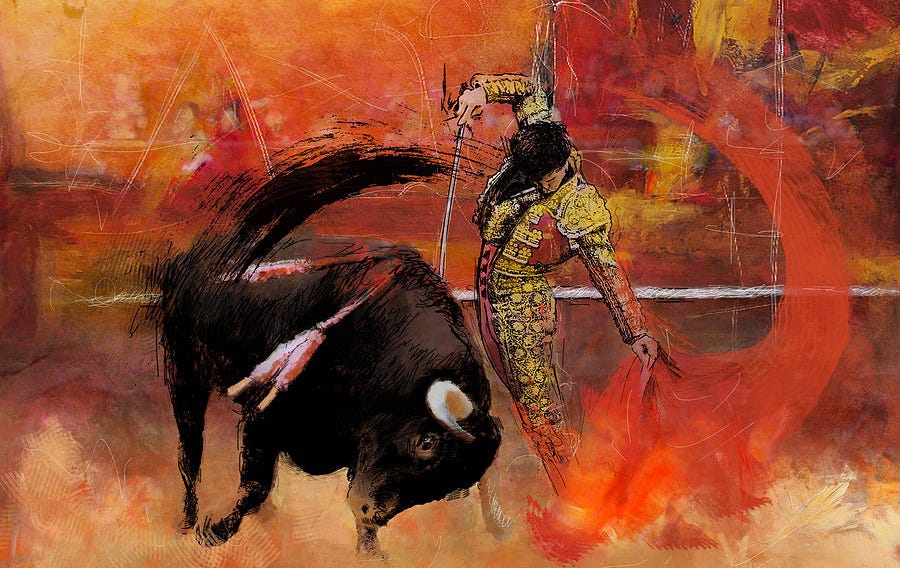
My first essay was on bullfighting. Truth be told, I don’t know why I chose that as a topic. Bullfighting is a sanguinary and brutal spectacle staged in three acts, where the bull is methodically weakened through repeated stabs to the back until the iconic dance—la faena—between the matador, the animal, and the red cape ensues, culminating in the bull charging straight toward its death. All I understood was that I felt admiration for the bull and the matador—but more so toward that magnificent bovine beast. In my rather rudimentary meditation, I said:
Through the bull we learn how to “struggle” in life. We learn how to face all obstacles along the way, those stormy nights, those mountains, those turbulent seas, with not so much as a complaint. A little bit of fierceness added to the mix wouldn’t hurt either.
You might stop me and say, “But, Dog, the bull is not conscious. It is bred to charge, and you said the bravura ethic was to confront ‘fate’ with “lucidity” just a paragraph ago!” Indeed, the bull in the corrida is an animal—unaware of its encounter with death or the endless ruminations of the ego masquerading as rationality. The bull enters the arena not knowing the script, not knowing the ritual death it is about to, in most likelihood, face. Yet, here the bull is revealed as a quasi-absurd hero. The bull’s condition is our condition unveiled. Are we not creatures of immense vitality, strength, and passion placed in an arena where death is certain, our struggle being ultimately “useless” in a cosmic sense?
In the eyes of those hordes of tame aficionados, the bull that fights with bravura charges repeatedly, doesn’t cower against the matador’s ceremonial humiliation, and attacks with undiminished fury as it bleeds and weakens. There, we find honor and nobility—in that lionhearted, determined effort. This is the logic of Sisiphus rolling his rock. Once he reaches the top, that rock will go downhill. Likewise, the bull will die. Friends, it is the manner of the struggle—the refusal to surrender—that transforms mere death into a crowning victory of lucidity and courage over the forces that crush it. The bravura ethic is an ethic of revolt.
The Matador and the Bull: A Shared Absurdity
The bull immersed in the ritual does not hope for a better outcome. It does not appeal to a higher power. Well, it certainly can’t, as far as I understand! Such is the wisdom of the bull. It fights to the bitter end. In this way, there is no self-deceit or confusion in its attitude. The bull is that Dionysian component of life: irrational, vital, brutish, ineffable, and chaotic. Contrary to the bull, the matador provides his share of Apollonian control, elegance, mystique, dandiness, and intelligence. Countless times, we can see that tension: the bull charging mere inches away from the matador’s leg.
This is precisely the Absurd made ritual. In the Myth of Sisyphus, Camus suggests that the Absurd is not mere ridiculousness, such as in a square circle or a prank gone wrong. The Absurd is the divorce between man’s desire for complete understanding and unity with the cosmos’s deafening silence on such matters. Both the bull and man, close to death, live most intensely—both members of the play must be fully present in this moment of truth.
The bull was raised precisely for those last 20 minutes of fighting. There is no future outside that coliseum. Much like Mersault after berating the priest in The Stranger, it has the freedom of the condemned man. The bull has nothing to lose, and so its every act must be pure, magnificent, and heightened. This shared absurdity is not lost on the matador either. He is just as condemned as the fighting bull in his existential condition. If the bull’s art, understood as its craft or exercise toward mastery, is the charge, the matador’s art becomes the adoption of strict, traditional forms during that final dance. Strangely, both members must face a bringer of death with resolve. This is the ethic of life lived to the maximum, ritualized in the bullfight for all to see.
All of these big words and elegies…“for what?” you might ask. Ultimately, it’s for nothing. The bull’s suffering and death? For nothing. The matador’s countless hours practicing his routine, his footwork, his dodges? For nothing. Really, the sum total of tercios, of a bull ramming a horse, of a picador with a lance stabbing the beast’s back, of the “ole’s” as the banderilleros dodge and plunge two small flags on the animal, and the bull’s final death as it runs to a sword in such a tragic play is useless in itself. No one is remaking the earth or creating zero-point energy here. All that we have is a completely useless flirting with death between man and nature. It goes without saying that thinking about such an event in terms of utility is short-sighted. We could be cynical and nihilistic about anything. Yet, both man and bull make one judgment that crushes such cynicism: they say “yes!” to life. This is all wholly part of the bravura ethic. We don’t say yes to life as a preparation for death. We say “yes!” because we cherish life in every circumstance and we strive to live beyond mere existence.
Revolt Against the Cruelty of the Boring World
Okay, but one thing is to romanticize bullfighting or Sisyphus—another thing is to romanticize the soul-crushing modern ‘struggle.’ Is “struggle” really the right word, however? The truth is that there is almost no strife nowadays. There is just the 9-5 grind. It is precisely the absence of struggle—understood as agonistic striving toward excellence or laboring for basic resources—that proves most debilitating. All in all, surviving is very easy. Sleeping late, waking up early, going to work, eating slop, doomscrolling yourself to sleep while barely being able to afford much in the way of luxuries is the standard. Can we still say “yes!” even in this Kafkaesque trial? If one must imagine Sisiphus happy, if one can imagine a bull in the arena happy—and they are, unlike what a dumb vegan would think—then what is there to say about you, my boring friend?
The typical obese man with a dead-end job is not striving. We should not believe that simply accepting “this is just how life is” is the correct approach, like a Zen Buddhist would—that you ought to eat, sleep, work, repeat, and not worry your little head too much about it! The bull could refuse to fight, too, after all. Nonetheless, nothing feels more profoundly wrong than giving up in the face of adversity. Perhaps, we ought to modify the question: can you say “yes!” while rebelling against the boring world with passion and love for life?
This is closer to the bravura ethic. The detached acceptance of our current case of gerontocratic capitalist managerialism and technological enframing—you know, riding the tiger as those feeble Traditionalists spout—is weakness. Worse of all, it’s way too easy. Anyone could give up. Let’s up the ante: if this world is that wretched, there is an easy way out. Just take that leap into the void, my cynical friend. But if you are reading this, like it or not, you are making the simple value judgement that life is better than death. I’m taking this a step further: drifting through mere life is lower than leading a higher life by the reins. Sisyphus loves pushing his boulder in the world as it is, and that’s living mere life.
The grandest cruelty of the modern world is that it is the joke that never quite lands. There is no great war, no manifest destiny, and no higher ideals to strive for. We are, at once, naked and without recourse. The bull is noble because it fights without hope by instinct. Sisyphus’s triumph is that he consciously finds happiness in the hopeless monotony of his task. But what if the heart of the bravura ethic is not merely lucid acceptance, but an active war against the very paradigm that makes our striving seemingly futile? After taking the calm path of Chuddhathustrian absurd acceptance, the next step is rebellion.
Sunbathing Vitalism Misses the Point
First, I will explain what I don’t mean by rebellion. Type “vitalism” into Google, and you’ll get a thousand images of shirtless men in the sun, raw liver on a wooden board, cold plunges while getting screamed at, or ripped men doing dead hangs. If you read that wretched book called “Harassment Architecture” by Mike Ma, you will see what I mean. His nameless protagonist “revolts,” but it is the Luddite’s revolt—the revolution of a man who wants to RETVRN to pasture, to sun worship cults and organic food lol. The message is deceptively simple: to say “yes!” to life is to negate our modern lame-stage-capitalism, destroy everything, and go back to tribal, supposedly more vital ways of living. This usually expresses itself in bodybuilding subcultures—it’s like Zyzz doing his dances while looking like a Greek god. This is vitalism as a consumer product and a dumbed-down aesthetic movement. I call it “sunbather’s vitalism,” and it’s fine as far as it goes. Yet, the sunbather vitalist rarely asks what happens when the body intrinsically malfunctions—when one lacks a couple of legs or is born with a chronic disease—when the will must overcome the body’s limitations (in a non-gnostic fashion) rather than display its exuberance. Indeed, what about “dysgenic vitalism”?
The disabled know something that the sunbathers forget: normality itself is a heroic task. For an autistic child who stumbles around with his speech or cannot play soccer, learning to converse, to read, to move through a ‘world’ that wasn’t built for him demands a kind of effort that healthy people reserve only for their grandest projects—if at all. This is what Peter Sloterdijk calls crippled existentialism in You Must Change Your Life—a condition where every ordinary action becomes an exercise in self-overcoming. These folks can’t simply drift through life as most of you do. One of the many ironies in Nietzsche’s corpus is that he valorised the strong and the well-bred while he himself was a lifelong sick hermit, plagued by migraines, vomiting, near-blindness, and unrequited love. In fact, little do people know that he criticises these simplistic health-seeking fools in Zarathustra’s prologue! The man who wrote Thus Spoke Zarathustra was the man who, six days before his descent to terminal insanity in Turin, signed his letters as “the Crucified.” After all, he lived a life of monumental suffering and turned that agony into the engine of personal transvaluation. It’s a complete mistake to understand him as one of those pagan-sympathising physical culturists.
The lives of the dysgenic reveal a deeper truth about the human condition. In Hesiod’s Theogony, Epimetheus—he whose name means “afterthought”—creates mortal creatures and forgets to give us natural defences: no fur, no fangs, no speed. Thus, both you and I enter the world crippled, not just the disabled. Prometheus then steals fire and gives us techne: the arts, crafts, sciences. We are the animal with no essence, forced to constantly invent new life tactics not just to survive, but to thrive. As Sloterdijk puts it, we are neotenic cripples who require “constitutive obstacles” to become anything at all. Society, language, discipline, technology—these are not luxuries; they are prosthetic extensions for a being born inextricably incomplete.
This is the key that unlocks a bravura vitalism worthy of the name. Most “vitalism” peddled today is little more than animal health or the glorification of tribal culture. It’s a celebration of having already won the genetic lottery by having broad shoulders, high endogenous testosterone production, and, in its lowest expression, letting your impulsive nature run rampant by falling prey to all sorts of base desires. But the bull in the arena, for all its magnificence, does not choose its charge; it is bred to it, as is the natural bodybuilder-sunbather-vitalist. True bravura enters when a being consciously turns its lack into a project or actively creates. The crippled do this visibly, but they only make explicit what is true of every man. Dostoyevsky had epilepsy; Napoleon likely had seizures; Nietzsche was a ruin of a man—yet each developed a tremendous will not in spite of their broken bodies but through them. They had to adopt a tryhard ethos just to trudge, and that ethos became a fire that burned brighter than the uncomplicated movements of the small-healthists. What I advocate is Nietzsche’s Great Health: a revaluation of our understanding in which suffering serves as a mechanism for transvaluation.
Crippled existentialism, therefore, transforms the bravura ethic from a mere cult of vitality into an art of self-overcoming against constitutive limits. The disabled are not the exceptions to vitalism; they are its purest exemplars because they cannot pretend their strength is a given. They must carve it out of recalcitrantly weak flesh every day, saying a joyful “yes!” to a seeming fate that gave them every reason to say “No.” And this, I want to suggest, is the face of rebellion. Again, my friends, refuse to ride the tiger like a Traditionalist defeatist who seeks to preserve spiritual purity for a putative Sanctum Regnum that is nowhere to be found. Our rebellion is a creative confrontation with the wounds built into existence itself.
This reframing sets the stage for a rebellion far larger than the individual body. If we are all born crippled and must ‘steal fire’ just to eat a meal or have a roof to sleep under, then we are not wrestling with this or that limitation but with those totalizing frameworks that stifle growth. That is the metaphysical rebellion Camus sketches in The Rebel—when we refuse the blind dictatorship of the One we say no, sure. However, we also say “Yes!” to living a better life in an act of solidarity for our fellow men. It is the rebellion of Prometheus against Zeus, of Cain against a God who rejected his offering. Shelley’s Prometheus in Prometheus Unbound and Byron’s Cain in Cain: A Mystery are not villains. Milton’s Satan is not a Don Quijote-like lunatic fighting against windmills. They are crippled existentialists writ large, taking the constitutive obstacle of a hostile cosmos and transforming it into a project of defiant self-creation. To that we’ll turn in a moment, but the logic is already laid down: if we are all unfinished creatures, the bravest act is not to polish our current condition but to revolt in a seemingly hopeless situation for the betterment, not only of ourselves, but of humanity.
The Metaphysical Rebel
The bull revolts against the matador; the disabled child revolts against his own wiring; the modern cubicle-dweller revolts against the flatness of administered life. These are local rebellions. The bravura ethic, pushed to its logical extreme, demands something larger: a rebellion against the very architecture that makes all local rebellions necessary—not in the hope of a final victory where the children of light beat the children of darkness for heaven to appear on Earth, but because some frameworks are not entitled to our consent. This is the step from Sisyphus to the Luciferian tragic hero.
Sisyphus, that great absurd champion, finds happiness in his rock. This is lucid acceptance raised to an art form. If our fate is a certain way, and we scream at the rolling tides to stop or at the moon to come down—as Caligula does in Camus’s play that bears that infamous emperor’s name—we are idiots if we become destructive nihilists because of it. But note what Sisyphus does not do because there: he does not turn and hurl the boulder at Zeus. He does not refuse the mountain itself. Camus betrays that leap toward betterment in his later “philosophy of limits,” where he reinvents the wheel by recasting Aristotle’s golden mean into a French word that largely meant the same thing: la mesure.
We must maintain the dynamic tension of the tightrope, balanced by contradictions, while steadfastly refusing extremist positions. For instance, the revolutionary utopianism of his Marxist contemporaries is dismissed as another extreme—an impossible totalitarian paradigm promising absolute freedom and perfect justice. In a surprisingly dull and humanist turn, Camus also rejects violence as a means of societal improvement, arguing it can never be justified, as if refusing to stain one’s hands with blood against a totalizing regime is somehow more ethical than leaving that order intact. Had Camus been a Navy SEAL during the operation against Osama bin Laden, he would have refused to kill him because a woman was used as a human shield—killing civilians is never legitimate after all for him. In his most questionable endeavor, he became an activist against capital punishment. This is evident in how his character Kaliayev refuses to bomb the Grand Duke in his play The Just Assassins simply because the Duke is riding with his nephews. Perhaps he truly was fond of exercises in futility. This is the Camus who preaches moderation while Zeus still sits enthroned. The bravura rebel cannot be so accommodating.
Hope, as Camus sometimes fears, can be the expectation that things will turn out well—the sedative that reconciles us to present misery. I am not arguing that hope is completely futile; a life without any horizon of possibility is clinical depression—doomerism left uncontrolled. But the bravura metaphysical rebel draws a line: hope must never become an excuse for tolerating a metaphysical framework that demands servitude. We rebel because the framework itself is insulting. The framework of the Abrahamic religions is retarded. The framework of the pagans is as stupid. I won’t argue against them for the gazillionth time here. The point is that these paradigms are still marred by the Retarding Spirit of Constraint—Angra Mainyu—and refuse the Spirit of Progress—Spenta Mainyu—as the Zarathustra of the Gathas would say. They claim that perfection is found in absolute obedience to the divine, that it was a mistake to eat the fruit of knowledge of good and evil, that it was a mistake to try to build a tower that would reach the heavens, and that it was a mistake to seek immortality.
One good gift has the fatal apple given,––
Your reason:––let it not be overswayed
By tyrannous threats to force you into faith
‘Gainst all external sense and inward feeling:
Think and endure,––and form an inner world
In your own bosom––where the outward fails;
So shall you nearer be the spiritual
Nature, and war triumphant with your own.
— Cain: A Mystery, End of Act II, by Lord Byron
For the metaphysical rebel, to refuse hope as a condition of action is to free oneself from the tyranny of outcomes. Byron’s Cain is the patron saint of this hopeless-yet-hopeful rebellion. In Cain: A Mystery, Cain does not murder Abel out of mere envy; he is driven to despair by the injustice of a creation that demands worship while offering only suffering and death. When Lucifer shows him the vastness of the cosmos and the insignificance of Earth, Cain is not comforted but radicalized. He sees that the human condition is a cosmic botch job, and his “crime” is, in part, a refusal to play along. Byron’s Lucifer says, “We must bear, // And some of us resist—and both in vain.” This is bravura. It is the recognition that hope, in a world authored by a tyrant—God—is just another chain. To refuse hope-as-bribe is the first raw motion of a being who would rather be shattered than reconciled to a shoddy creation.
Standing against these sorts of traditional metaphysical frameworks is the first step in philosophy and, also, leftism. In Reason and Revelation, Leo Strauss is correct when pointing out that “philosophy is radically atheistic.” Only the left seems to understand that today, yet it portrays itself in very strange ways. The “left” as we know it today is definitely a combination of woke moralism, enlightenment utopianism, and philosophical materialism—Marx being an exponent of this way of thinking. But the specters of Marx run much, much deeper. The primordial leftist position, for lack of a better term, is one of victimhood, yes, but one based on rebellion against fixed ontological structures, against the reign of the “Supreme Being.” This root is essentially Promethean, and Marx was well aware of it. It represents a rebellion in the name of human progress on its own terms, against supposed divine hierarchies. It’s a desire to become the architects of our own divine ascension through philosophy and science. Hence why Marx says this:
Prometheus is the most eminent saint and martyr in the philosophical calendar. — Marx
Shelley’s Prometheus goes further, purifying the impulse. In Prometheus Unbound, Prometheus is chained to a rock for stealing fire and giving it to humanity—the ultimate act of metaphysical rebellion. He knew the punishment before he acted; he acted anyway. What I want to stress is that Prometheus is a father figure who wanted the betterment of mankind, and he accepts his eternal binding precisely because he loves what he has created. He suffers the vulture, the cold, the chains, not out of pride, but out of a paternal refusal to let his children freeze in the dark. At last, the play reunites Prometheus and Asia (love). His rebellion is not to become a mirror of the oppressor but to suffer for others without becoming cruel, to create without demanding repayment. Prometheus endures, and his endurance itself becomes a kind of victory—not a victory over the tyranny of Jupiter (that comes later, almost as an afterthought), but a victory over the temptation to let suffering curdle into resentment. This is the bravura rebel’s highest form: the one who steals fire for a world that may never thank him, and does it anyway, without hope of reward or even of success.
Then, there is Milton’s Satan in Paradise Lost, who supplies the most seductive and dangerous kernel the bravura ethic can redeem. Seen as the tragic hero par excellence, I want to recover his spirit in its sharpest form: “Better to reign in Hell, than serve in Heaven.” Byron’s Lucifer cries a similar sentiment: “If the blessedness // Consists in slavery—no.” Strip away the theodicy and the fallen angel’s bombast, and you find a being who would rather endure eternal torment in a reality he helped shape than enjoy bliss in a totalizing metaphysical framework imposed upon him. The problem with Milton’s Satan is not his rebellion but his motive: pure ego, the desire to reign because of a wounded pride. The bravura rebel transfigures this: not “better to reign” but “better to suffer for the chance that others might one day not have to.” The freedom he claims is not the freedom to dominate; it is the freedom to refuse a cosmos that asks you to kneel. When Camus insists that rebellion must observe limits, that it must never become violent or absolute, he fails to see that this politeness leaves the totalizing framework unchallenged. To rebel within la mesure is to play by the tyrant’s rules; the status quo hums along, undisturbed. Sometimes the only way to say “no” to a totalizing order is to break the order’s own commandments—to steal fire, to take the mark of Cain, to reign in Hell if that is the only kingdom where kneeling isn’t mandatory.
What unites these three figures—Cain, Prometheus, and even the salvageable core of Satan—is that they are crippled existentialists writ cosmic. Each is bound: Cain by his exile and his mark, Prometheus by his chains and his vulture, Satan by his banishment to Hell. Each turns that binding into the site of a value-creating act. They make their limitations, whether the determinism of a clockwork universe ruled by a God or the injustices of a tyrant against your children, the very ground of their defiance. This returns us to the dysgenic kid who must construct a vital project starting from hostile psychophysiology, to the bull bleeding in the arena yet charging with relentless fierceness, to all you Last Men who refuse to let your soul be flattened into a spreadsheet without complaining tirelessly like most. The metaphysical rebel extends this logic to the ultimate limit: the totalizing framework itself is the constitutive obstacle, and the stolen fire is every act of meaning, beauty, and solidarity we hurl against it—whether or not the framework falls.
This is the bravura ethic in its full flower: a lucid, generous war against totalizing frameworks, whether they wear the face of God, Jupiter, or the managerial machination of being. Prometheus gave fire to mortals as a father gives to his children, and for that, he accepted the vulture. The fire didn’t make humans immortal. It didn’t abolish suffering. It just made the struggle a little brighter and a little freer. The freedom to say “no” to a cosmos that demands a slave’s devotion—that, finally, is the bravura ethic’s response to the cruelty of the boring world and the silence of the heavens. We are all cripples born into an arena with no exit. We can charge like the bull, magnificent and doomed, and that is already noble. The tall task is to steal fire anyway, to give it away in an act of overflowing abundance, and to say, as the chains close around us, that it is better to be free in Hell than a slave to any God. We don’t hope to be rescued—we rescue ourselves. We have made a judgment that the totalizing framework is illegitimate, and that judgment, even if the cosmos never answers, is the one thing in the universe that was not here before we made it. We rebel and forge a better world even if it seems futile now.
This is the bravura ethic against servitude found in the transgression of the “sacred.” It may be useless. It may be doomed. It is the only thing worth doing. It is living more than mere life.
To suffer woes which Hope thinks infinite;
To forgive wrongs darker than death or night;
To defy Power, which seems omnipotent;
To love, and bear; to hope till Hope creates
From its own wreck the thing it contemplates;
Neither to change, nor falter, nor repent;
This, like thy glory, Titan, is to be
Good, great and joyous, beautiful and free;
This is alone Life, Joy, Empire, and Victory.
— Prometheus Unbound, Act IV, by Percy Shelley
Bruce Lee can be added to this list, whila physical culturist, the man was small even for a Chinese and in no way given his physical fitness genetically.. his caracture in Naruto, Rock Lee born unable to do ninjutsu, with no special physical talent exept one, was my childhood hero, he was "a genius of effort".