

Why the "Based" Warrior Needs to Stop Fixating on Homer and Start Reading Heraclitus
A slop-free walkthrough of Heraclitus' fragments.

This collection of aphorisms on Heraclitus is designed to mimic the experience of waking up from a 2,500-year-old collective hallucination. You’ll encounter my critically acclaimed “Dogian Aphorisms” (and dialogues) that cut through dry academic fog and constant Substack surface-level 5-min-reading-time book-report slop, revealing many secrets in plain sight that you haven’t heard of Heraclitus. Each aphorism builds on the previous one, so read them in order and cross-reference them later. The goal? To demonstrate that Heraclitus is more BASED than Homer, something that, oddly enough, everyone—from the “flux” new-agers to the Traditionalists—seems to have missed. We encounter a philosopher who is obviously far from the “peaceful” lie of the Epicureans but also of the formlessness of the Daoists, and who is keenly focused on a this-worldly strife that holds reality together. Heraclitus is the harbinger who calls the “best” to rise in a world ruled by a child playing dice, of all things. So step into the river NOW!
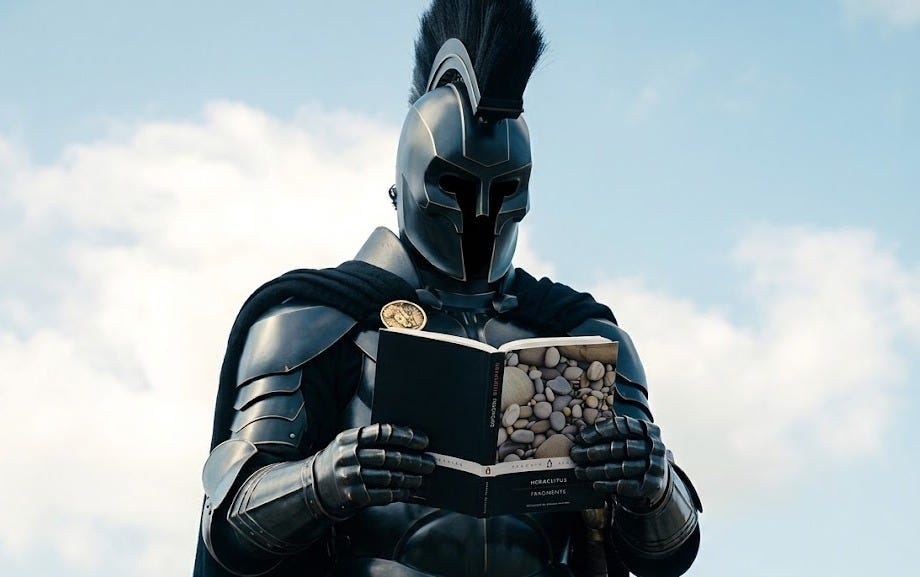
I. Hesiod, Homer, and the “Sleepwalkers” of the Ancient World
§104
"What wit or understanding do they have? They believe the poets of the people and take the mob as their teacher, not knowing that ‘the many are worthless,’ good men are few."§B42
"Homer deserves to be expelled from the competition and beaten with a staff, and Archilochus likewise."§B57
"Hesiod is the teacher of most; they believe he knew most, who did not recognize day and night: for they are one."§B73
“We should not act and speak like men asleep.” [Paraphrased by Marcus Aurelius]
With these words, Heraclitus lays bare his disdain for the revered poets, Hesiod and Homer. That contempt may catch many on the modern right off guard, since they are so often told to trudge through the Iliad—a bore of a read—as a path to based enlightenment—while, in the same breath, content creators pump out Heraclitus quotes glorifying strife and war. It raises a sharp question: why would Heraclitus see those who take the poets as their teachers as sleepwalkers?
To answer that, I have to introduce you to one of the greatest theories of the twentieth century: GREEK ZOMBIES. I’ve mentioned in passing elsewhere that the Iliad doesn’t spring from a single author. The works attributed to Homer—whose name literally means “bard”—are amalgamations of legends stretching from the Bronze Age into the Iron Age, built to function as tribal encyclopedias. As the illiterate Mycenaean population grew and migrated across the Peloponnesus, seeding the scattered Greek city-states, bards preserved their culture and techniques by surrendering to rhythm, meter, dance, and mnemonic devices—by becoming “musical”—and reciting the luminous words that would etch themselves into the Western mind for thousands of years.
Ingenious as that oral technology was, a closer look at the Iliad or the Odyssey reveals something startling: these archaic Greeks had no concept of the self. In an ironic twist, the real BRONZE AGE MINDSET is having no idea that such a thing as “mindset” exists at all! This shouldn’t be surprising to anyone who has seriously read Nietzsche’s middle period, as Nietzsche claims that the formation of herd-mentality arrives first in the process of civilization before the development of the ego, which for him is a fiction anyway. On the idea of traditional Greek morality and customs, these quotes should help us:
Human, All-Too-Human by Friedrich Nietzsche, Pt. I. §96:
“[Tradition] is above all directed at the preservation of a community, a people.”Human, All-Too-Human by Friedrich Nietzsche, Pt. II. §9.
“The origin of custom goes back to two thoughts: ‘the community is worth more than the individual’ and ‘an enduring advantage is preferable to a fleeting one’; from which the conclusion follows, that the enduring advantage of the community is to take unconditional precedence to the advantage of the individual.”1881 Notebook:
“Egoism is something late and always still rare: the herd-feelings are stronger and older!”
This is not a far-fetched idea. Many anthropologists and even Traditionalist philosophers like Alexander Dugin understand this concept. These Greeks possessed what Julian Jaynes, in his seminal work The Origin of Consciousness, called “a bicameral mind.” Instead of conscious deliberation, they acted on the divine ordainment of the gods. Arrows found their mark through holy magic, and fates swung by divine favor. As Jaynes notes:
“When Agamemnon, king of men, robs Achilles of his mistress, it is a god that grasps Achilles by his yellow hair and warns him not to strike Agamemnon” (p. 72).
Words that would later come to designate the ego didn’t exist yet. Take thumos, one of our favorite terms in the BASED WARRIOR space. We usually reach for it to mean that passionate spirit simmering in young men. But in the Iliad, its meaning is far more concrete: it refers to motion, agitation. To put it briefly, we are to understand this:
“The Trojan War was directed by hallucinations. And the soldiers who were so directed were not at all like us. They were noble automatons who knew not what they did.” (p. 75)
“Noble automatons”—just as Ramakrishna tells the simple villager asking for the key to happiness, “Totally accept the fact that you are a machine operated upon by God.” The Bhagavad Gita would be right around the corner, with Lord Krishna telling Arjuna that war is fated and only his disposition toward it makes him noble or not.
The archaic hoplite was living in a “dream” in a literal way. It is only until Book IX of the Iliad, written much after the Bronze Age, that we encounter the first vestiges of that mind which Saint Klages despised so utterly. In Book IX (312-313), Achilles says: "Hateful to me as the gates of Hades is the man who hides one thing in his heart and speaks another." Jaynes notes: "This is definitely an indication of subjective consciousness." (p. 82)
The gods pulling the strings was the very language their collectivist psyches used, a stand‑in for the conscious decision‑making they lacked. And this is the pre‑conscious, god‑driven, strangely traditionalist mindset Heraclitus encountered when he sat down to write in the solitude of the Temple of Artemis in Ephesus in the late 6th century and early 5th century BCE.
II. Much Learning Does Not Teach Understanding: Why Smart People Are Still Stupid
Sometimes I’m amazed at people who obsess over Star Wars—the kind who can recall minute details far beyond character names and plotlines. And I shouldn’t even get started on the Lord of the Rings fans who learn Elvish, or the Protestants who commit the entire Bible to memory. Heraclitus would call this polymathie: “much learning,” which “does not teach understanding.”
§B40
“Much learning does not teach understanding; otherwise it would have taught Hesiod and Pythagoras..."
In his day, people were just as consumed with Hesiod’s endless genealogies of gods and mythic stories as modern Orthobros who endlessly read the “church fathers,” trying to find some esoteric truth hidden in the texts.
Plato, in his critiques of the sophists, would often point out that these men knew a ton of fun facts and used myth to spread what sounds like the Truth for financial or political gain. They were deeply knowledgeable, and yet—how many of us don’t know intelligent people who utterly lack wisdom, be it of the practical or spiritual kind? In this, Plato is nothing but an echo of Heraclitus. Let’s dissect this previously mentioned quote:
§B57
“Hesiod is the teacher of most; they believe he knew most, who did not recognize day and night: for they are one.”
At first glance, that looks like a bizarre hill to die on. In Hesiod’s Theogony, day and night are separate entities that take turns traveling—a curious artifact of ancient thinking, mirrored in how the Aztecs and Egyptians imagined the sun god fleeing from the moon. Here is the full passage:
(ll. 744-757) There stands the awful home of murky Night wrapped in dark clouds. In front of it the son of Iapetus stands immovably upholding the wide heaven upon his head and unwearying hands, where Night and Day draw near and greet one another as they pass the great threshold of bronze: and while the one is about to go down into the house, the other comes out at the door.
And the house never holds them both within; but always one is without the house passing over the earth, while the other stays at home and waits until the time for her journeying come; and the one holds all-seeing light for them on earth, but the other holds in her arms Sleep the brother of Death, even evil Night, wrapped in a vaporous cloud.
The first real insights into astronomy in the Greek mind came from the natural scientists—the pre-Socratic philosophers like Thales, Anaximander, and Anaxagoras—who were the original empiricists. They grasped that day and night are not two warring gods but a single, continuous process: one whole, the 24-hour cycle we now take for granted. The ardent followers of Greek tradition, much like Christian fundamentalists who reject evolution in favor of Young Earth Creationism, would reject this new, world-changing knowledge. For Heraclitus, Hesiod was essentially spewing nice-sounding nonsense because he was a poet, not an astronomer.
I’ve always told my friends, even regarding woo-woo stuff like psi-phenomena, that we must be empiricists. It’s easy to blurt out things confidently, be it the existence of God, hell, or magic—mere hearsay. But why should we believe these things? They could be real, and indeed there is proof for a lot of woo if you are a radical empiricist—someone who, like William James or Henri Bergson suggested, doesn’t automatically deny some lines of thought because they are impossible under a putative scientific materialism which is as wrong as the Abrahamic framework and takes all available evidence into account. This radical empiricism is inherently phenomenological, as it incorporates testimony and conclusions drawn from sensory experience. The preference for wide, direct experience beyond the second-hand bullshit from the priests or useful idiots is explicit in these fragments:
§B55
"All that can be seen, heard, experienced: these are what I prefer."§B101
"Eyes are more accurate witnesses than ears"§B35
"Men who are lovers of wisdom (philosophoi) must be inquirers into many things"
We see a parallel critique of Homer in another fragment:
“Men are deceived in the recognition of what is obvious, like Homer, who was wisest of all the Greeks. For he was deceived by boys killing lice, who said: what we see and catch we leave behind; what we neither see nor catch we carry away.”
The irony is thick. Heraclitus calls Homer “the wisest of all Greeks” precisely because Homer was baffled by a simple riddle—a riddle he allegedly could not solve, dying of grief over it, just as tradition says he went blind in old age. The point cuts deeper than the anecdote: men are deceived in seeing only the apparent. The metaphor is that the “many”—hoi polloi—fail to recognize the Logos even though it sits right in front of them, woven into their everyday lives.
III. Cargo Cults, The Hermeneutic Circle, and Why Barbarians Would Make Dumb Witnesses
Friends, imagine you are a bunch of Pacific Islanders who’ve never seen an airplane. One day, apparent silver birds roar down, pouring fire from the sky, and out spill boxes of meat in cylindrical silver shapes (cans), instant death-pebble cannons (guns), and sticks that one must fire up and inhale (cigarettes). Essentially, you see cargo. The white men in strange (military) uniforms wave glowing sticks, talk into metallic boxes with strange symbols (walkie-talkies), and more flying machines come. For years, they summon resources from the heavens! Then the war ends, the runways they built with solidified grey goo (airstrips) go quiet, the sky falls empty. These islanders are now starved for the goodies, and do the only thinkable thing their World (yes, in Heidegger’s sense lol) permits: they build bamboo mock‑ups of control towers and sculpt headphones out of coconut halves, shuffling in formation, doing calisthenics, lighting signal fires, you name it. In their minds, this must surely get the goodies to RETVRN, dropping like Fortnite loot from the sky! Alas, they are imitating the surface rituals without the underlying machinery, logistics, supply chains, and science. They saw the same things the GIs saw, heard the same crackle of radio static, yet their eyes and ears bear false witness because they lack the conceptual skeleton that would make the phenomena intelligible. They are barbarians in exactly Heraclitus’s sense.
I brought up Homeric automatons in my previous aphorism. The cargo cult is the same zombie‑dream. This brings us straight to Heidegger’s hermeneutic circle, a piece of phenomenology the online right desperately needs but mostly distorts into a meme about “worldview warfare” they heard from some debate-bro. Heidegger’s point, stripped of his signature CLUNKY-babble, is simple enough: you never encounter any fact as a virgin. Every act of understanding leaps into a pre‑existing World—language, culture, religion, techniques, etc. A World is a totality of involvements and references that you already “dwell” in—HUGE words. Basically, you interpret the strange through the familiar, the new thing through your known paradigm. The islanders fitted the impossible apparition of cargo planes into their mythological‑ancestral (so, woo-voodoo) framework. They interpreted modern logistics as a gift from the spirit world (or whatever they believed in particular) because that was the only hermeneutic loop they could spin. Intelligent as we may find ourselves to be, the hermeneutic circle can’t be escaped. Imagine the Greek Zombies Heraclitus is talking about as he, and the other philosophoi, encounter that, for example, solar eclipses can be predicted by looking at the stars and no magical sacrifice is necessary to “summon” them. After all, some fragments also show his disdain for those who practice religious rituals. The problem is not to be found in our ability to perceive sense data—we can all see eclipses after all. The problem is having a paradigm so deficient that it cannot admit, at least for Heraclitus, the “Logos.”
In §B55 he told you he prefers “all that can be seen, heard, experienced.” He tells you to become a radical empiricist who doesn’t numb his senses with second‑hand priest‑talk. However, he does seemingly contradict himself when he drops this:
§B107
"Eyes and ears are poor witnesses for men who have barbarian souls."
Barbarian, barbaros, are those whose speech sounds like “bar‑bar‑bar.” They are all foreigners, people whom the Greeks, by and large, considered subhuman. A barbarian soul for him is structurally incapable of digesting sensation into knowledge. The sensory data is real—in the case of the Pacific islander: the plane really lands, the loot really drops. However, the witness is flawed. Just as the islander sees a silver fuselage and registers “divine metal bird” while a logistics officer sees a C‑47 with a fuel‑to‑payload ratio, the “many” in Heraclitus see day and night, war and peace, or life and death as separate deities wrestling on Hesiod’s bronze threshold, rather than a single, self-evident rhythmic pulse. The data is identical, the Logos is public, but the decoder ring is missing. This is why demanding “just the facts” from the many is like handing a differential equation to a man who calls numbers “shape‑spirits.” He’ll perceive something—heck, some even pontificate about it at length—yet he won’t grasp the concept.
The same contempt saturates this next quote:
§B17
"Most men do not understand such things as they encounter them, nor do they recognize them when they have learned them, but they seem to themselves to do so."
Not only do these ancient Greeks with barbarian souls stumble past the Logos in direct experience, but even after some smartypants has pointed at the puzzle pieces, they still don’t recognize the pattern. They acquire a cargo‑cult education: how many Substackers don’t repeat that “strife is justice,” yet they continue living as if peace is the norm. They’ve heard the account, but they remain “untried,” wandering about in a fog of seeming comprehension. Any internet veteran who’s watched an Orthobro quote the Philokalia or a Catholic quoting Aquinas while being incredibly rude to intellectual opponents or gluttonously devouring every passion under the sun knows exactly what this looks like. Yes, I hate Jay Dyer—how did you realize that, friend?
§B34 “Uncomprehending when they have heard, they are like the deaf: the saying describes them as present while absent.”
The deaf hear nothing, so their non‑comprehension at least matches their sensory vacuum. The men with barbarian souls are worse off: they are present—the vibrations hit their eardrums, the plane crosses their retina—yet they are simultaneously absent. Again, sleepwalkers. They occupy space on the scene but fail to show up to the clearing—more Heideggerianese for the curious. Their “hearing” is a parody of perception, a biological reflex divorced from intelligence. The cargo cultist standing with his coconut headphones is the living emblem of this fragment: present among the bamboo mock‑ups, absent to the radio waves passing invisibly through his skull because such thought is too difficult to comprehend. Only someone raised in modernity could understand electromagnetic waves, walkie-talkies and flying machines. Perhaps that’s why Heraclitus thought that the adults of Ephesus should hang themselves, and the city be left to the uncorrupted children. The epistemic gap is so wide that only a radical break—handing the city to children or educating the Vanuatuans from birth in Western-style schooling—might create a new hermeneutic backdrop that enables them to wrap their heads around modern technoscience.
Heidegger called this “thrownness” into a World that pre‑interprets everything before you open your mouth. Heraclitus, being far less of a tedious German, calls it having a barbarian soul or not. The “many” are always already cargo‑cultists of their preconceived notions. A modern Christian could be abducted by aliens in a UFO, and he would believe it was demons raping him. There are many other cargo-cultists today: of philosophical basic-bitch materialism, modern archaeology, or those who believe the world is just numbers and they calculate everything on egoistic utilitarian grounds. Whatever it is, remember that
§B123:
"Nature (Physis) loves to hide"
Disclosure needs unconcealment, sure, but it also needs concealment (lethe) as a reservoir from which it can draw. Heraclitus understands truth not as a fixation, a correspondence, or a tautology as we normally do nowadays (veritas), but as something elusive meant to be discovered (aletheia). Our current paradigms reveal many insights impossible for the ancients, such as the aerodynamic principles that enable flight. Yet, this same modern technological paradigm also blinds us and creates a disenchanted world of machinations.
IV. You Can Step Into the Same River Twice: The Lie About Heraclitus
Heraclitus is usually remembered as the philosopher of pure flux—the sage who declared that you can never step twice into the same river. After all, he did say that “all things flow” (panta rhei). The main culprit behind this confusion, speaking as the BASED Nietzscheans and Heideggerians we are, is once again Plato. In the Parmenides, Theaetetus, and Sophist, Plato constructs a metaphysical cage match between two radical extremes: the Heraclitean doctrine of endless flux and the Parmenidean doctrine that nothing ever happens.
Consider the problem. If everything is always changing, how can we ever define anything statically? If everything is always the same, what can we say about the world where time visibly flows and change occurs? When Aristotle claims in the Metaphysics that Plato’s forms are metaphysical blueprints floating out there in a noumenal realm, he’s only half right. Plato himself presents these extremes as “offhand stories” told to children, using their inherent absurdities to carve out a middle path for his own Theory of Forms, which he sometimes suggests when having Socrates throw spaghetti at the wall in his dialogues. At bottom, the forms are nothing more than “standards” or “first principles.” What Socrates does with his dialectical method, with his relentless questioning, is jarringly interrupt the dream language of the Greeks.
How can we know what nobility is if Achilles sometimes acts ignobly, and yet we are told we must act like Achilles? Virtues are not like chairs or tables—tangible objects. They are invisible. Under deep questioning, Socrates concludes that we still don’t know the form—the first principle—of courage, nobility, or beauty, but that it must exist somehow. Plato isn’t just an idiot who “didn’t get it”—his own teacher, Cratylus, was a Heraclitean. He is someone who notices the hordes of Greeks simply regurgitating the lines of the bards. By asking “What do you mean?” Socrates forced speakers to rephrase poetic images into prosaic, abstract formulas, thereby disrupting the pleasurable complacency of the poetic trance. This is why Plato’s Academy taught boys mathematics and not just wrestling. Mathematics has clear, fixed answers, and constant engagements with these types of problems would lift the young Greek men away from predetermined, traditional mere claims. The blindness plague from Homeric legend was to be cured with Plato’s pharmakon: rationality and his forms.
And yet, having traced the caricature of Heraclitus back to Plato’s staging, we now need to deconstruct that caricature itself. I’m sorry to say, friends, but Heraclitus did not believe in pure flux. He is no Nagarjuna, Zhuangzi, or Deleuze. You may have heard that Heraclitus says you can’t step into the same river twice, but that is not what he actually said. Those are later paraphrases, especially Plutarch’s. Rather than advocating random, chaotic transition, Heraclitus teaches what Heidegger calls “perseverance in change” and “sameness in alteration” in his sections on Heraclitus in his Basic Concepts of Ancient Philosophy. Let’s look at the real fragment:
§B12
“On those stepping into rivers staying the same, other and other waters flow”
To shake off any preconceived notions, pay attention to the phrase that identifies rivers as “staying the same.” According to Heraclitus, some things do stay the same—this is not pure flux, friends. What the fragment reveals is a strange paradox of stability through change. The waters may flow onward, but what makes a river, whelp, a river is precisely that the waters course through it. If there were no stream, we would have a pond or a dry streambed. Some things stay the same, yes, but only by changing. The river’s identity is one of form, not of material substance.
Digging deeper into the Greek, I learned something valuable about Heraclitus’s characteristic ambiguity. The phrase “the same” (toisin autoisin) can grammatically link either to “rivers” or to “those stepping in.” A parallelism is implied: the river remains the same despite changing currents, and the person remains the same despite the flow of their parts—hair, skin, but also habits and moods. Something like psychic continuity is suggested beneath the incessant flow. This means Heraclitus was no Daoist or Zen Buddhist who thought the self was an illusion. Sure, we are never the same from one moment to another, but something like the self persists over time.
IV.I Further Dialogue:
[Friend #2134123412’s objection]:
All of this could have been wrapped up in “The more things change, the more they stay the same.”
Aristocratic Dog’s response:
It’s more like, “some things only stay the same by changing.”
[Friend #2134123412’s further objection]:
Well that doesn’t make any sense, especially if you’re going to have qualifiers applied to only “some things” as opposed to others.
Aristocratic Dog’s response:
He is definitely NOT saying “the more things change, the more they stay the same.” That is more Anaximander’s apeiron and less Heraclitus because it implies a hidden, static substance (arche) underneath all change. Heraclitus, not you or me, is definitely saying that “some things only stay the same by changing.” This is a cornerstone of Heraclitean thought: the paradox of stability through change.
Read the example of the river again. It makes perfect sense. What Heraclitus considers the Logos is, partly, this imminent process of change, which is the only constant. If a river’s waters stopped flowing (as per the analogy), it would not be a river—it would be a pond. Not everything operates this way at the level of human experience. Water will always be H2O no matter what (material persistence). On the other hand, a river stays the same by constantly changing (a dynamic form). Heraclitus elevates this to the level of the soul as well. You remain “you” not because your atoms or who you consider ”you” stay the same forever, but because there’s a pattern that persists through constant change.
In philosophical jargon, he is suggesting that identity doesn’t require fixed forms, unlike how Plato would later exoterically insist on. There is something like process-based identity rather than a substance-based one. It’s a case of a formal cause vs. a material cause. I understand this is complicated to envision, precisely because we moderns reduce what an entity “is” to its substance. However, Heraclitus is pointing out a truly ancient way of thinking about what an entity “is.”
V. The Everliving Fire: Why the Universe Is Just a Cosmic Cycle of Generation and Destruction (According to Heraclitus)
§B30
“This world-order [kosmos], the same of all, no god nor man did create, but it ever was and is and will be: everliving fire, kindling in measures and being quenched in measures.”
The phrase “everliving fire” is unmistakable in its imagery—fire has no fixed shape, shifting from moment to moment. Calling it “everliving” might tempt us at first glance to think this fire is simply eternal. But pay close attention, friends, to the second half of the sentence: this fire goes in and out, not arbitrarily, but “in measures.” That is a perplexing riddle, and another fragment helps us decipher it:
§B31
“The reversals of fire: first, sea; and of sea, the one half is earth, the half is burning wind (prēstēr). … Sea is poured out and measured to the same proportion as it existed before it became earth.”
Heraclitus is describing a balance of elements in the typical alchemical transformations of fire, wind, sea, and earth. The idea is not far from what chemistry now calls the law of conservation of mass: mass cannot be created or destroyed, only rearranged through different states. When the “sea” is transformed, Heraclitus notes, it “measures up to the same amount it was before.” Once again, a stable underlying order reveals itself amid the constant flow of basic materials.
This is why Aristotle—and even Nietzsche—missed the mark when they claimed Heraclitus believed the world is literally made of fire, just as other pre-Socratics proposed water or air as the fundamental element. The symbol of fire remains far more useful than that, suggesting what Spengler called “energetic metamorphosis.” Fire is subject, as Heraclitus understood, to this “law of measures” even in its apparent restlessness. In a world viewed as pure movement, the only thing that remains firm is the rhythm, the beat of that movement—and that beat is the Logos.
Yet there is more. Fragment §B30 tells us this fire is also “kindled” and “quenched” in measures—meaning it has a beginning and an end. Yes, friends, Heraclitus believed in cosmic cycles, though not of the strict Traditionalist variety. In fragment §B31 he speaks of the “reversals” (tropai) of fire. The term tropai literally refers to solstices—the turning points of the sun—suggesting that the cosmos undergoes a large-scale seasonal pendulum swing between elemental extremes. Nietzsche, an ardent follower of Heraclitus, echoes this belief with his eternal recurrence: “the absolute and eternal repetition of all things in periodic cycles.”
The Stoics considered themselves the true heirs of Heraclitus, and they firmly believed in ekpyrosis—the great world-conflagration in fire. That may sound wild until we add the following fragments:
§B65
“Fire is need (chresmosyne) and satiety (koros).”§B66
“Fire coming on will discern and catch up with all things.”
The Stoics interpreted “Need and Satiety” as developmental stages of the cycle. They identified Need with the construction of the world order (diakosmēsis) and Satiety (koros) with the conflagration, when the fire has devoured all available fuel. Recall that Nietzsche’s eternal recurrence, properly grasped as the grand metaphysical declaration of cosmic cycles, posits that while time is infinite, the number of possible forces in the cosmos is finite. Once every conceivable arrangement of these forces has occurred, the cycle restarts. That vision directly echoes the Stoic picture: fire eventually consumes all fuel, a great flood (cataclysmos) washes it all away, and the whole thing begins anew, like a phoenix, with a great fire.
VI. OKAY, BUT WHAT THE HELL IS THE LOGOS, DOG?
Another interesting bit here is that Heraclitus, for starters, believes in a "world-order" (kosmos) that manifests as "everliving fire". This is somehow linked to the Logos. I know what you are wondering now: “What is the Logos?” If you guys come from a Western/Christian background, you might recall that the Gospel of John states “God is the Word (Logos).” And so, by way of mindless cultural reinforcement, you might connect these two. This isn’t without merit. At its most basic level, Heraclitus does use that word as “account,” “discourse,” “reason,” or “foundation” (ratio). The key as to why it is a “ratio” has been answered previously: the world goes in and out or is transformed in proportionate measures. This is all understandable.
But Heraclitus goes deeper in his polysemy. His fragments can be interpreted in various wild directions due to his ambiguity. For Spengler, as mentioned previously, the Logos is purely energetic—the purely immaterial process or rhythm of the world. As the most exemplary ‘prophet of doom’ as he is, Spengler doesn’t leave his Stoic brothers behind by far, identifying the Logos with fatalism. Remember that Spengler isn’t going the way of metaphysical decline into materialism as in the Kali Yuga in his seasonal history of ascents and declines—Evola heavily criticized Spengler for his ‘anti-metaphysicalness’ and extensive use of biological metaphors in his own preface to his Italian translation of The Decline of the West. For Spengler, as for Nietzsche and the Stoics, the Logos being partly identified with fatality is simply the mechanical and inevitable necessity that drives the “eternal return” of the cosmic cycle. What I mean is that if Spengler, Nietzsche, and the Stoics came to this conclusion, it must have some merit.
For Heraclitus, the Logos is some form of objective reality that is self-evident, yet the many remain blind to it.
§B1
Although this account (Logos) holds forever, men ever fail to comprehend, both before hearing it and once they have heard. Although all things come to pass in accordance with this account, men are like the untried when they try such words and works as I set forth...§B2
The account (Logos) is common, but most men live as if they had a private understanding.§B50
Listening not to me but to the report (Logos), it is wise to agree (Homologein) that all things are one.
Now, clearly, for most people this isn’t self-evident at all. Therefore, it would explain why most fail to ‘see’ the Logos. If you remember those pendulum swings from one measurement to the next, the cosmic cycles, life and death, and how Heraclitus called Hesiod an idiot for not realizing day and night are actually the same process, then it makes sense that "Logos" is all about showing how opposites are really just two sides of the same coin. The Logos is ALSO the harmonious unity of opposites. This is not something I’m pulling out of nowhere.
§B48
"The name of the bow is life (Bios); its work is death."§B51
"They do not comprehend how a thing agrees at variance with itself; it is an attunement turning back on itself, like that of the bow and the lyre."
Heraclitus uses the imagery of a bow and a lyre to show how something can be at odds with itself. The bow only works because the string and the wood are pulling against each other; that tension is what makes the whole thing stable and functional. This…
§B54
“hidden attunement” (harmony) is better than the obvious one.”
VII. Harmony Without Discord is Nothingness
When Heraclitus says that "All things are one," this is not used in the New Age sense where we sing “We are The World” while closing our eyes, swaying around, and holding hands during Earth Day. "Harmony" is achieved through conflict in Heraclitus’ philosophy. And this conclusion doesn’t come from a vacuum, but from a profound dialogue in antiquity. The only quote that remains to us today of Anaximander, one of the philosophers before Heraclitus, is this:
"They pay penalty and retribution to each other for their injustice in accordance with the ordering of Time."
In Anaximander’s cosmology, the universe is made of opposing elements, much like Heraclitus’, of hot and cold, wet and dry, etc. However, for Anaximander, whenever one element extends its domain and dominates its opposite, it commits an "injustice." Still, in Anaximander, we see the ill-conceived typical ancient connection between morality and nature. He thinks that over time, nature forces that dominant element to pay the penalty by retreating, which allows the suppressed element to take its turn—thus balancing the cosmic scales. That’s why Heraclitus answers this way:
§B80
We must recognize that war is common and strife is justice, and all things happen according to strife and necessity.
Recall everything that I have mentioned thus far about the unity of opposites. For Heraclitus, justice is the total pattern of the domination of one opposite followed by another, maintaining a "hidden attunement" that is superior to any obvious, static peace. And you know who was not BASED enough to see that this strife is eternal? Homer LOL.
§B81
"Homer was wrong when he said 'Would that Conflict might vanish from among gods and men!'... For he was praying for the destruction of the cosmos"
Yes, ‘Homer’ desired a peaceful world. As we have come to understand, this "world-order" is found through strife, through the unity of opposites, through the destruction of one thing to form another. For Heraclitus, demanding peace is demanding stagnation, and if this cosmos is an "everliving fire," Homer could only truly be desiring its annihilation. Friends, there is no harmony without discord. There is no music without highs or lows, without notes that don’t fit only to be refitted through a new harmony, a counterpoint, or a melody. That’s why "war" (polemos) is highest of all, and we live in a state that Jorjani has coined "metapolemos."
War isn’t merely destructive. The ecstasy of creative destruction is the necessary backdrop for a cosmos without lifeless uniformity. The desire for peace, for ataraxia, for aponia, and worst of all, for the beatific vision—the retvrn to the One itself—is weakness borne of a desire for something unimaginable. This is the strange paradox of strife and multiplicity, of the ‘monism=pluralism’ that Heraclitus and Deleuze uphold. “Being the One” doesn’t really work because its infinite, eternal nature would actually make it the same as ‘Nothingness,’ which by definition can’t exist or let ‘us’ “be.” The world of the many is the only possible expression of reality. Existence requires an "irreducible multiplicity of microcosmic consciousness" as Jorjani mentions in his early notebooks published in Metapolemos, because a single, unified consciousness would collapse back into that impossible void. “The One is the Many,” as Nietzsche would say in his lecture on Heraclitus. Without this perpetual wrestling of opposites and power centers, nothing would hold reality together.
VIII. The Soul’s Gathering—Or Why You’re Not a Ghost in a Machine
We’ve dismantled Homer’s bronze-age zombies, compared the “many” to cargo‑cultists, and understood what the hell is the cosmic fire that’s kindled in measures. But we’ve left out the most foundational, the most BASED question precisely because it sits at the base: what does it mean to “BE” at all? Yes, I will attempt to solve life’s deepest mystery in this one aphorism. We will have to get a little poetic here.
Forget the Christian soul, the New-Age/Traditionalist mumbo-jumbo, or the pop‑psychologist telling you to optimize yourself like a project, my friends. Heraclitus—via Heidegger’s maddeningly, if not entirely frustrating, brilliant lens—tells us the soul (psyche) is not a substance as we usually think but a gathering power. Heidegger, in his set of essays titled Early Greek Thinking, retrieves the meaning of Logos from the Greek legein, meaning “to harvest” or “to gather.” He defines the Logos as the “original assemblage of the primordial gathering.” It is the power that unifies all things (hen panta) and lets them “lie before” us in their presence. This is a highly idiosyncratic and perplexing reading, hence why I deliberately passed over it in the section on the Logos. But this is getting somewhere, promise, friends.
The word soul (psyche) originally meant “breath,” so much so that during the Iliad it had absolutely nothing to do with the soul as soul. Psyche as “breath” is also not equivalent to oxygen—how the hell would they have reached that modern conclusion? Heidegger figures out something that seems obvious when pointed out, yet entirely out of sight until you think about it: what if the “soul” is taken as a metaphor for the act of breathing? Indeed, the soul (psyche) for Heraclitus is the rhythmic draw‑in and draw‑out that makes you the place where Being (Dasein) happens. This necessarily mirrors the act of things transformed in equal quantities in measures or cosmic cycles, which we discussed as also part of the Logos. You’re not a subject peering at objects, a spirit trapped inside machinic meat, organs, poop, and bones that must find a way to relate to the exterior. You’re the safekeeper of unconcealment itself because without you, nothing could be known. You are the “lightning‑flash” that illuminates beings, allowing them to be recognized as what they are. Animals are trapped in their environments and instincts, while you are the one who can hear the Logos in the first place.
§B45
“You will not find the limits of the soul, even traveling every road; so deep is its Logos.”
The easy interpretation is something like “the human psyche is infinitely complex.” But that would be too simple for Heraclitus and even more so for Heidegger, who can make a walk in the park the most complex of meditative states. The “depth” is the soul’s far‑reaching harvesting, its ability to gather the farness of Being into itself. Let’s recall this fragment:
§B2:
“The Logos is common, but most men live as if they had a private understanding.”
The structure of Being is co-extensive with the structure of the universe. To know yourself is to discover the structure “common to all.” The “many” walk around in their private worlds of opinion (doxa), believing that their little grievances, their petty ambitions, their curated identities are the whole story—analogous to Ortega y Gasset’s mass man or Heidegger’s the They. The proper move is homologein—to “say the same” as the Logos. Not to parrot Heraclitus, Heidegger, or the Aristocratic Dog back, but to align your own “gathering” with the cosmic gathering.
§B50
“Listening not to me but to the Logos, it is wise to agree that all things are one.”
That’s the noble task: reflective thinking (phronein) as the highest nobility, because it attunes you to the voice that holds all opposites in tension.
Yet we’re always already forgetful.
§B72
“They are at variance with the Logos[…] with which they are in constant association. And what they meet with every day seems strange to them.”
Being is the nearest yet most distant—like radio waves for an uncontacted tribe. Is it that out of touch to say that we are the opening that allows any “object” to be known? Being is the clearing (Lichtung) that allows any such “whatness” to show up in the first place. Perhaps our hubris is nothing more than taking our own petty needs as the measure of reality, a scorching flame that blinds us ultimately. But the cure stands ready: §B118—“A dry soul is wisest and best.” Sober, unmoistened by the doxa of the many, the dry soul is closest to the everliving fire.
IX. Aristocratic Radicalism
This idea of conflict as justice also goes hand in hand with Heraclitus’ elitist vein. Heraclitus was born into one of the most prominent aristocratic families of Ephesus, a Greek settlement in Persia. He was the eldest son and thus inherited the title and office of “king” of the Ionians no less! However, in a bewildering sign of detachment from worldly affairs, he resigned this title to his younger brother. According to Diogenes Laërtius’ Life of the Philosophers, when asked by the citizens of Ephesus to write a constitution, he refused. Heraclitus rejected the request because the city’s government was already thoroughly corrupt. Instead, he walked away to the Temple of Artemis, sat down with the local children, and began playing a board game with them.
This elitism took a sharper turn when, apparently, the citizens of Ephesus banished a certain Hermodorus, their “best man,” because “no one should be the best among us.” Consequently, Heraclitus said that all adult Ephesians “should hang themselves” and leave the city to the children (§B121). He wouldn’t abandon this temple for the rest of his life, only leaving us this enigmatic set of aphorisms behind. This is why the many are blind, retarded, and completely worthless to him.
Heraclitus, like many modern thinkers (me), compares the majority with cattle who are only concerned with comfort, safety, and sating their base animalistic desires rather than choosing to live the examined life or to go down in flames, gloriously, like Icarus. The majority are idiots who, in the times of Heraclitus, relied on the bards and the mob as their teachers, remaining blind by way of a collectivist spell. It appears that nothing is new under the sun. We still live with these same zombies all these thousands of years later. We must remember:
§B29
"The best choose one thing above all else: everflowing fame among mortals; but the many sate themselves like cattle."§B49
"One man is ten thousand to me, if he is the best."
These views inform the aristocratic radicalism present in Heraclitus’ political philosophy. Conflict for Heraclitus is also diagnostic. It "shows" or designates the status of beings. In a literal sense, ancient battle determined who became a slave and who remained free. Philosophically, it distinguishes the mortal (men) from the immortal (gods).
§B53
"War is father of all and king of all; and some he has shown as gods, others men; some he has made slaves, others free"
This quote explains why Heraclitus favored the aristocratic hierarchy, arguing that social and cosmic ranks aren’t fixed or random. Instead, they’re built through the constant struggle that drives necessary change. The best will prevail, and those who take the heroic choice are the ones who attain a spiritual reward. Perhaps we don’t live in times of heroes and great battles any longer. However, something rings right to me when I see these quotes, even if they are stripped of all karmic flirtations:
§B24
"Gods and men honor those who fall in battle."§B25
"Greater deaths are allotted greater destinies."
X. How to Play the Turn-Based Game of Cosmic Fire
§B52
The Aion is a child at play, moving pieces in a game; kingship belongs to the child.
We are finally ready to dissect this quote, which all of you have surely heard of. It is rather enigmatic, and if a picture of Lord Zeno from Dragon Ball Super is the first thing to pop up into your mind, you are halfway there. “Aion,” to my great surprise, means “vitality” or “lifetime.” Yes, yes, Vitalist Magazine can now appropriate the term “Aion” for further propagandistic purposes without losing legitimacy—hurray. Furthermore, this is specifically designated to the duration of a human life and not time in any abstract scientific or philosophical sense. “Aion” is also a cognate of aiei, which means “always,” and it is intrinsically connected to the “ever-living fire” (aeizoon).
I’m not flexing my ancient Greek here because, truth be told, I don’t know the language. I have only come to learn these things upon studying secondary literature for Heraclitus. What this has shown me is that by naming the player “Aion,” Heraclitus is referring, again, to rhythmic transformations of the cosmos in this game of life where there are winners and losers. The game being played is pessoi, a turn-based board game that involves moving pieces with dice. A few things may come to mind immediately: the back and forth of turns imitates the “measures” of the cosmic fire, which is “kindled in measures and quenched in measures”. After one side plays, it’s the turn of the other. The use of dice signals that the game has an element of fortune in its definite rules.
Why does “kingship (basileie) belong to the child”? Recall that “War is the father and king of all” as well. This suggests that the "game" of the child and the "war" of opposites are the same cosmic process viewed from different perspectives. Just as the bow is named "life" (bios) but works death, the ruler of conflict and destruction is named "lifetime" (Aion) and appears as an innocent child.
I like how Nietzsche goes about this, friends. In Philosophy in the Greek Tragic Age, the German thinker famously interpreted the child as a symbol of "perpetual innocence" in the process of Becoming. He compared the Aion to a child building and destroying sand heaps by the sea—piling them up only to knock them down again in a joyous, aimless impulse. The world-process is not a moral courtroom with karma at the end of the line, but an artistic game played purely for its own sake. As players in the game, Nietzsche tells us to align with the ethos of the Übermensch. Nietzsche got this from Heraclitus (and probably modeled it after Goethe’s Faust):
§B82
“The most beautiful of apes is ugly compared to the human race.”§B83
“The wisest of men will appear as an ape compared to a god.”
Nietzsche modifies this in the prologue to Zarathustra to say:
"What is the ape to man? A laughing-stock or a painful embarrassment. And man shall be just that for the Übermensch: a laughing-stock or a painful embarrassment."
So there’s your board, friends. The pieces are already laid out: war and peace, life and death, hunger and satiety, ape and god. The dice are in your hand—they will be thrown, and you must make a play. You might be in a bad position for now, but fortune and cunning may better your odds. Will you meet the roll of chance with the laughing innocence of the child who builds castles only to kick them down and start again? The Aion doesn’t play for a final victory because it doesn’t exist. The game is its own reward, and the only “best” worth becoming is the one who plays it with style, courage, and the kind of reckless excellence that makes the cattle wince. Remember, you are a crossing, and when you die, the game will continue. Will we be closer to the Übermensch when your time runs out? It’s up to you and me, my friend.
This will take a few read-throughs to properly understand this, it's a bit beyond my limited intelligence. I'll also have to do some further reading as to be quite honest, I haven't read any of Heraclitus before and this is all new to me.
Two things, stand out to me here mind you, which others might dismiss as bollocks, but we'll see...
Firstly, the ability for 'something' to remain a fixed entity despite a waxing and waning, or flow state seems to far more accurately explain our universe than the idea of fixed states or a strict hierarchy of forms. (As a side note, this does finally solve the puzzle of the Ship of Theseus.)
Secondly, the idea of the universe consisting of this waxing and waning essence, being neither in a state of eternal creation, nor an ominous destroyer, in my opinion seems close to what Penrose has been talking about with what he called 'conformal cyclic cosmology', where the cycle repeats endlessly on like a fractal, flowing endlessly from one state to the other.
I think, especially if you deny the existence of any singular Homer, it’s not right to think of the man as having “beliefs” that he implanted into the Iliad and the Odyssey, let alone some sort of overarching theme. The Iliad is about glorifying Achilles and all of his excellence, and to a lesser extent some of the other major warriors on both sides. The Odyssey is about Odysseus in the same way… Homer is anti-war in a sort of “do as I say and not as I do” kind of way. His characters tell the reader “oh, war is so bad, I’m so hung up about it”, but you’re the one reading about them for their martial feats. It’s like the mafia boss who drives around in his sports car, wearing pinstripe suits, and living in a mansion telling his son to be a doctor and avoid the life. Ultimately the only way out of strife in Homer’s world is through engaging in heroic violence.
I don’t think Homer is boring. I think the Iliad and Odyssey are both great fun, but they can be an awkward read because they’ve been completely twisted away from their original cultural context. Nobody should read them as “self-help” books. The only people who could use the advice of the Iliad and Odyssey are, like, Maasai herders or Afghan highlanders. It’s not gonna help you be a better stockbroker or auto mechanic lol